Auto detailing is a measured process of cleaning, decontaminating, correcting, and protecting a vehicle’s surfaces—not simply a faster version of a car wash. For Greater Metro Detroit owners, that distinction matters because winter salt, gritty road film, automatic-brush scratches, brake dust, pollen, lake-effect moisture, and summer UV exposure all create different problems. A proper detail begins with the vehicle’s condition and the owner’s goal, then matches labor, chemistry, tools, and protection to that need.
What Auto Detailing actually includes
Auto detailing is best understood as surface restoration and preservation. The work may include the exterior, interior, engine-bay surfaces, wheels, glass, trim, or a combination of those areas. It can be a maintenance service for a daily-driven SUV, a correction project for a sports car, a delivery-preparation process for a dealership, or a protection plan for a boat, motorcycle, RV, bus, or commercial vehicle.
A wash removes loose and bonded contamination. Detailing goes further by identifying what remains, determining whether it can be safely removed, and deciding whether the surface should be polished or protected afterward. The sequence matters: polishing a dirty panel can drag abrasive particles across the paint, while applying protection over traffic film traps the very contamination the owner wanted removed.
Cleaning, decontamination, correction, and protection
These terms describe different jobs:
- Cleaning removes loose dirt, dust, food residue, oils, and ordinary road film from paint, wheels, glass, and interior surfaces.
- Decontamination targets bonded material such as rail dust, industrial fallout, tar, tree sap, and embedded grit that washing alone may not remove.
- Correction uses controlled polishing to reduce the visual effect of swirls, oxidation, haze, water spotting, or other defects. It does not mean every defect can or should be removed.
- Protection adds a sacrificial or more durable surface layer, such as a sealant, wax, ceramic coating, or paint protection film, according to the vehicle and use case.
- Reconditioning combines several operations to improve presentation, sale readiness, usability, or long-term preservation.
The right service is therefore not determined by vehicle size or paint color alone. A lightly used garage-kept coupe may need a careful decontamination and protection service. A work truck may need interior extraction, wheel cleaning, paint-safe salt removal, and underbody attention. A dealership vehicle may need a repeatable process that produces consistent delivery condition without spending retail-detail time on every unit.
What it is not
Detailing is not a guarantee that a vehicle will look permanently new. Paint thickness is finite, clear coat can be damaged, leather and vinyl can be permanently stained, and neglected surfaces may require replacement rather than cleaning. A professional recommendation should identify those limits before work begins.
It is also not appropriate to use one aggressive chemical or one machine-polishing approach everywhere. Wheel finishes, matte paint, gloss paint, plastic trim, coated glass, leather, cloth, and marine vinyl all respond differently. Product selection must follow the material, contamination, temperature, dwell time, and required finish.
Why detailing matters in Metro Detroit conditions
Detroit-area driving creates a practical maintenance problem: contaminants are not merely cosmetic once they remain on a surface long enough to interact with moisture, heat, or the material itself. Road salt and brine can collect in seams, wheel areas, rocker panels, and underbody cavities. Brake dust can bond to hot wheel finishes. Tree sap and bird residue can etch paint when left in place. Interior moisture can contribute to odor and staining, especially when floor mats and upholstery are repeatedly exposed to snow and wet clothing.
Contamination becomes harder to remove with time. That does not mean every mark is permanent, but it does mean the safest correction window can narrow. A technician may be able to remove a fresh sap spot with a targeted process; an old, hardened deposit may have etched the clear coat and require polishing. The objective is to remove the contaminant while sacrificing as little original material as possible.
Paint and trim consequences
Road film is a mixture rather than a single substance. It can contain oily residue, mineral material, fine grit, and salt. A strong cleaner may cut through some of it but could also stain sensitive trim or dry an unprotected surface if used carelessly. A gentle wash may be safer but insufficient for bonded contamination. The decision is a trade-off between cleaning strength and material safety.
Paint correction presents another trade-off. Polishing can improve clarity by leveling or refining the upper surface around defects, but each correction process removes or abrades some clear-coat material. A shallow defect may justify light refinement; a deep scratch that catches a fingernail may not be safely removable without unacceptable risk. The professional answer may be to reduce its visibility rather than chase complete elimination.
Interior health, comfort, and usability
Interior detailing is not just about fragrance. Dust, food residue, pet hair, spilled drinks, and moisture accumulate in seams and porous materials. A useful process removes the source where possible, extracts residues from fabric, cleans high-touch areas, and dries materials thoroughly. If visible mold or extensive water intrusion is present, ordinary detailing may not be the correct remediation path. The CDC’s mold guidance explains why moisture control and appropriate cleanup decisions matter when mold is suspected.
For families, the work may center on car seats, floor mats, and sticky residue. For fleet operators, it may center on repeatable sanitation and turnaround. For a motorcycle or powersports vehicle, the challenge is often mud packed around controls, chain areas, suspension components, and textured plastics. For a boat or jet ski, the process must account for marine vinyl, non-skid surfaces, saltwater residue, and the need to avoid forcing water into electrical areas.
- Daily driver: prioritize salt removal, glass clarity, floor mats, and a manageable protection layer.
- Sports car: prioritize paint inspection, wheel-face and barrel cleaning, defect reduction, and careful drying.
- Truck or SUV: prioritize rocker panels, wheel wells, interior utility areas, and paint protection on exposed surfaces.
- Motorcycle or ATV: prioritize mud removal without driving contamination into bearings, controls, seals, or electrical connections.
- RV, bus, or commercial vehicle: prioritize safe access, material compatibility, consistent appearance, and downtime control.
How a professional detailing process works
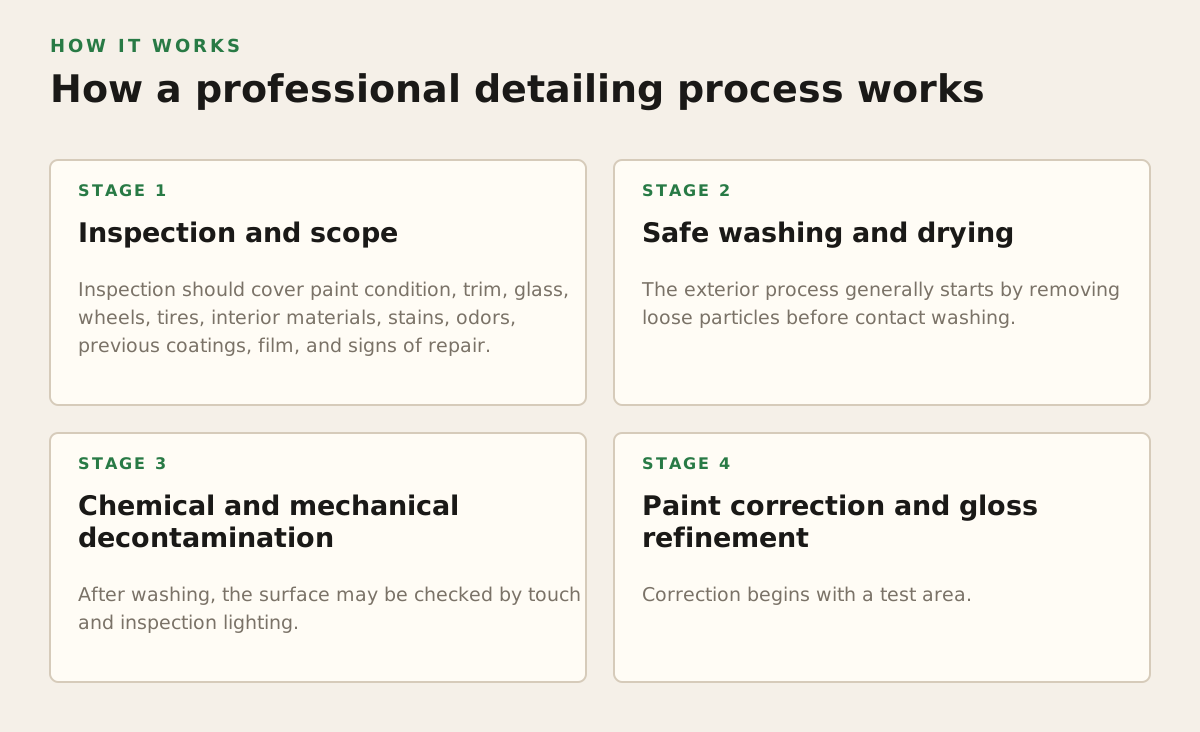
A sound process is diagnostic before it is aggressive. The technician should inspect the vehicle, identify the materials and defects, discuss the intended use, and establish what “finished” means. A delivery-ready dealership vehicle, a concours-style sports car, and a salt-exposed commuter do not need identical procedures.
1. Inspection and scope
Inspection should cover paint condition, trim, glass, wheels, tires, interior materials, stains, odors, previous coatings, film, and signs of repair. Lighting changes what can be seen: a vehicle may look clean in diffuse daylight while showing heavy haze or wash marks under focused illumination. The technician should also note areas that require caution, including loose trim, failing clear coat, repainted panels, delicate decals, and aftermarket accessories.
Condition determines the process. A quoted service should distinguish between “clean and protect,” “improve gloss,” and “correct defects.” Those are different outcomes. If the owner expects a deep scratch to disappear, the conversation belongs before polishing begins.
2. Safe washing and drying
The exterior process generally starts by removing loose particles before contact washing. Pre-rinsing, appropriate cleaner selection, controlled agitation, and frequent media rinsing reduce the chance of dragging grit across the finish. Wheel tools should not be moved casually from a heavily contaminated wheel to delicate paint because brake dust and road grit can create avoidable marring.
Water quality, surface temperature, shade, and drying technique affect results. Products allowed to dry on hot paint or glass can leave residues or mineral spotting. A detailer may divide the vehicle into smaller sections, rinse more frequently, or alter chemical dwell time when conditions change.
Mobile and fixed-site operators also need to consider runoff. The U.S. Environmental Protection Agency’s guidance on mobile vehicle-wash facilities discusses stormwater considerations for wash water and helps operators plan a more responsible wash setup rather than allowing contaminated runoff to reach a storm drain.
3. Chemical and mechanical decontamination
After washing, the surface may be checked by touch and inspection lighting. A chemical process can be selected for particular contamination, while a mechanical decontamination medium may remove bonded particles. Neither should be treated as a universal cure. Excessive pressure, repeated passes, or unsuitable lubrication can create marring that then requires polishing.
Tar, sap, mineral deposits, and iron-bearing fallout each need different reasoning. A product that dissolves one contaminant may do little to another. A technician should use the least aggressive effective approach, observe the result, and stop when the surface is clean enough for the next stage.
4. Paint correction and gloss refinement
Correction begins with a test area. The purpose is to learn how the paint responds to a particular pad, polish, machine movement, and number of passes. A mild combination may improve gloss and reduce fine wash marks while preserving more clear coat than a heavy compound. A stronger combination may be justified on harder or more severely marked paint, but it carries more risk and still may not remove deep defects.
Correction is controlled compromise. The best-looking result is not always the result with the most material removed. On a daily driver, preserving paint for future maintenance can be more valuable than pursuing maximum defect removal. On a vehicle being prepared for sale, improved uniformity and clarity may matter more than chasing isolated defects that buyers will never notice.
5. Protection and aftercare
Protection may be a wax, sealant, ceramic coating, or film system. A ceramic coating is not a substitute for washing, and a protective film is not a license to ignore contamination. The substrate must be properly prepared because protection preserves the condition beneath it. Applying a durable layer over staining, heavy mineral deposits, or visible residue can lock in an inferior finish.
Products should be used according to their manufacturer instructions, including preparation, curing, ventilation, and maintenance requirements. For workplace handling, the Occupational Safety and Health Administration’s Hazard Communication resources explain the role of labels, safety data sheets, and employee information when chemical products present hazards.
- Illustrative starting policy: inspect and document the vehicle before work, including existing scratches and damaged trim.
- Illustrative starting policy: perform a small test area before committing to a compound, stain remover, or aggressive brush.
- Illustrative starting policy: keep wheel, tire, interior, and paint tools separated unless they are cleaned and verified suitable.
- Illustrative starting policy: complete a final inspection in more than one lighting condition and record any defects that were intentionally left for safety.
Where detailing breaks down
Most disappointing outcomes come from a mismatch between the vehicle, the requested result, and the process—not from a lack of product. A neglected vehicle may need more time than a maintenance detail. A freshly repainted panel may need curing guidance from the body shop before aggressive cleaning or protection. Matte finishes require different expectations because polishing can permanently alter the sheen.
Common technical limits
- Deep scratches: if damage reaches deeply into the paint system, polishing may only soften the appearance.
- Clear-coat failure: peeling or delaminating clear coat cannot be restored by ordinary correction.
- Permanent staining: dyes, rust-colored contamination, and chemical burns may have altered the material.
- Odor sources: fragrance can mask an odor temporarily when the source is trapped moisture, spilled liquid, smoke residue, or biological contamination.
- Water intrusion: wet carpet or headliner problems require locating and repairing the leak, not merely drying the visible surface.
- Loose or damaged trim: cleaning around a failed adhesive or brittle plastic can expose a pre-existing weakness.
There are also operational limits. Large RVs, buses, semis, boats, and commercial equipment may require special access, water management, height planning, electrical precautions, or a staged schedule. A fleet manager should define acceptable turnaround time, inspection standards, and whether vehicles can be removed from service. Retail owners should identify whether the priority is appearance, preservation, odor reduction, sale preparation, or long-term protection.
Why shortcuts create repeat work
Rushing the drying stage can leave water in mirrors, emblems, grille openings, weather seals, and trim gaps. Aggressive interior brushing can raise fabric fibers or damage delicate surfaces. Excess dressing can create a greasy appearance, attract dust, or reduce pedal and steering-wheel grip. Over-polishing can produce a temporarily impressive finish that has sacrificed too much paint for a defect that will return visually under different lighting.
“More aggressive” is not the same as “more professional.” A practitioner should be able to explain what a product or tool is intended to remove, what material it contacts, what could go wrong, and how the result will be maintained. If that explanation is missing, the customer cannot evaluate the recommendation.
How practitioners apply detailing to different jobs
The most useful service plan connects the process to the vehicle’s work. A personal vehicle owner may want easier maintenance after winter. A sports car owner may care about reflected clarity and reduced wash marring. A dealership may need consistent presentation across many units. A fleet manager may value repeatability and downtime more than a show-car finish.
Personal vehicles and SUVs
For a Metro Detroit commuter, a sensible plan often starts with a thorough exterior wash and decontamination, wheel and wheel-well cleaning, interior vacuuming, spot treatment, glass cleaning, and a protection option that fits the owner’s maintenance habits. The recommendation should account for parking: a vehicle stored outside faces different contamination and drying conditions than one kept in a garage.
Owners should ask whether the service includes door jambs, floor mats, cargo areas, wheel faces, and visible trim. They should also ask how paint defects will be handled. “Detail” can mean a careful clean, a one-step gloss enhancement, or a multi-stage correction; the written scope should make that distinction clear.
Trucks, sports cars, motorcycles, and powersports vehicles
Trucks often collect heavy contamination behind the wheels, along rocker panels, and beneath bed hardware. Sports cars may have low clearance, delicate finishes, large brake systems, and soft paint that shows marring quickly. Motorcycles, dirt bikes, and ATVs introduce exposed controls, chains, radiators, suspension components, decals, and electrical connections. Water pressure and chemical dwell time need more restraint around those areas.
For these vehicles, the owner should disclose aftermarket wraps, powder coating, ceramic protection, vinyl graphics, repaired panels, and unusual materials. A motorcycle that is used in mud needs a different maintenance schedule from one stored indoors and ridden only on paved roads. A powersports detail should not replace mechanical inspection or lubrication where the manufacturer requires it.
If stone impact is the primary concern on a truck or sports car, discuss ppf separately from detailing. Film is a physical barrier for selected painted areas; it does not correct a dirty substrate, protect every component, or remove the need for careful washing.
Boats, RVs, buses, and commercial vehicles
Large and specialty vehicles reward planning. A boat may need attention to gelcoat, marine vinyl, non-skid decking, metal hardware, and salt residue. An RV may combine automotive paint, decals, fiberglass, roof materials, awnings, and interior fabrics. Buses and commercial vehicles may require access control, route scheduling, and a repeatable inspection checklist.
For dealerships and fleets, the key question is not simply “How clean can it be?” It is “What condition must every unit reach, how will that condition be checked, and how often should maintenance occur?” A written checklist can cover exterior contamination, glass, wheels, high-touch interior areas, cargo zones, odor, trim, and damage documentation.
| Vehicle or account | Primary objective | Important decision |
|---|---|---|
| Personal commuter | Salt and soil control with easy upkeep | Choose a protection method the owner will maintain |
| Sports car | Gloss, defect reduction, and preservation | Set a safe correction limit before polishing |
| Motorcycle or ATV | Mud removal without forcing contamination into sensitive areas | Control water pressure and tool selection |
| Boat or RV | Material-specific cleaning and weather exposure management | Separate automotive surfaces from marine or specialty materials |
| Dealership or fleet | Consistent presentation and predictable turnaround | Use a documented scope and inspection standard |
Underbody condition deserves its own decision, especially for vehicles exposed to winter salt. Detailing the visible paint does not equal corrosion control; owners comparing services should review rust prevention undercoating, which helps them choose a rust-prevention undercoating service for road-salt corrosion and understand the difference between surface cleaning and long-term rust prevention.
Choosing the next service
Use the vehicle’s condition and intended use to choose the next step:
- Choose a maintenance detail when the vehicle is fundamentally sound and needs regular cleaning.
- Choose decontamination when paint feels rough after washing or shows bonded road and industrial residue.
- Choose paint correction when wash marks, oxidation, or haze are the main visual problem and sufficient paint remains.
- Choose a coating when the owner wants a durable protection system and will follow its maintenance requirements.
- Choose film when selected painted areas face repeated stone impact or abrasion and a physical barrier is appropriate.
- Choose reconditioning when the vehicle needs coordinated interior, exterior, trim, glass, and presentation work before delivery or use.
- Choose rust-prevention work separately when salt exposure and underbody corrosion are the concern.
The best recommendation is specific: what will be cleaned, what will be corrected, what will remain, what protection will be installed, and how the owner or account should maintain it afterward. For Metro Detroit personal vehicles, dealerships, fleet accounts, boats, RVs, motorcycles, powersports vehicles, buses, and commercial equipment, Rite-Way Auto Reconditioning can help match detailing, paint correction, ceramic coatings, Icon Rocklear paint protection, window tinting, rustproofing, and undercoating to the vehicle’s actual use. Start the conversation through Rite-Way Auto Reconditioning and ask for a scope based on condition rather than a generic package name.
Want it done for you? See our auto detailing service at our Romeo shop, or call (586) 651-4007.