Ceramic coating auto detailing is a paint-care service that combines surface preparation with the application of a thin, chemically bonding protective layer over a vehicle’s existing finish. The coating can make washing easier, increase water behavior, and help the paint resist some environmental contamination, but it is not a substitute for careful washing, paint protection film, or repairs to damaged clear coat. For Greater Metro Detroit owners, the useful question is not whether a coating is “permanent” or “scratch-proof”; it is whether the preparation, product selection, and maintenance plan match the vehicle’s exposure.
What Ceramic Coating Auto Detailing actually includes
A ceramic coating service has two separate parts: paint correction and preparation, followed by coating installation and aftercare. Treating the coating as the whole service misses the step that most affects the final appearance. A coating follows the shape and condition of the surface beneath it. Swirls, oxidation, embedded particles, water spots, and sanding marks can remain visible after application if they are not addressed first.
The coating is a thin protective film, not a replacement clear coat
Automotive ceramic coatings commonly use silicon-based chemistry that forms a cured, cross-linked film when applied and allowed to react under the manufacturer’s specified conditions. “Ceramic” is a useful category name, but it does not mean the vehicle receives a thick sheet of fired ceramic. Silicon dioxide itself is a compound with a defined chemical identity, as documented by the U.S. National Library of Medicine’s PubChem reference; commercial coating formulas may also contain other resins, solvents, additives, and modifiers.
That distinction matters because coating thickness is limited. The layer can change surface energy and provide a sacrificial barrier against some contamination, but it cannot rebuild missing clear coat, straighten a dent, fill a deep gouge, or make a soft painted panel immune to impact. A stone striking the front of a truck at road speed is an impact problem, not merely a water-beading problem.
Preparation determines what gets sealed in
Professional preparation normally involves a sequence tailored to the vehicle rather than a universal checklist. It may include:
- A careful wash to remove loose dirt without grinding it across the paint.
- Chemical and mechanical decontamination to remove bonded rail dust, industrial fallout, tree residue, or road film.
- Inspection under controlled lighting for oxidation, sanding marks, water spotting, and previous repair work.
- Paint correction when the owner wants defects reduced before protection is installed.
- Panel wipe or another residue-removal step so polishing oils do not interfere with bonding.
- Application in a controlled area with attention to temperature, humidity, dust, panel size, and wipe timing.
Not every vehicle needs the same correction level. A newer daily driver may need cleaning and light refinement, while a black sports car with years of tunnel-wash swirls may need a more involved correction decision. A dealership vehicle, fleet van, boat, or motorcycle may require a different balance between appearance, downtime, and serviceability.
The related service sometimes called a coating should therefore be evaluated as a process, not just as a bottle or badge. Ask what will happen to the paint before the product is applied and what maintenance the installer expects afterward.
Why the protection matters in Greater Metro Detroit
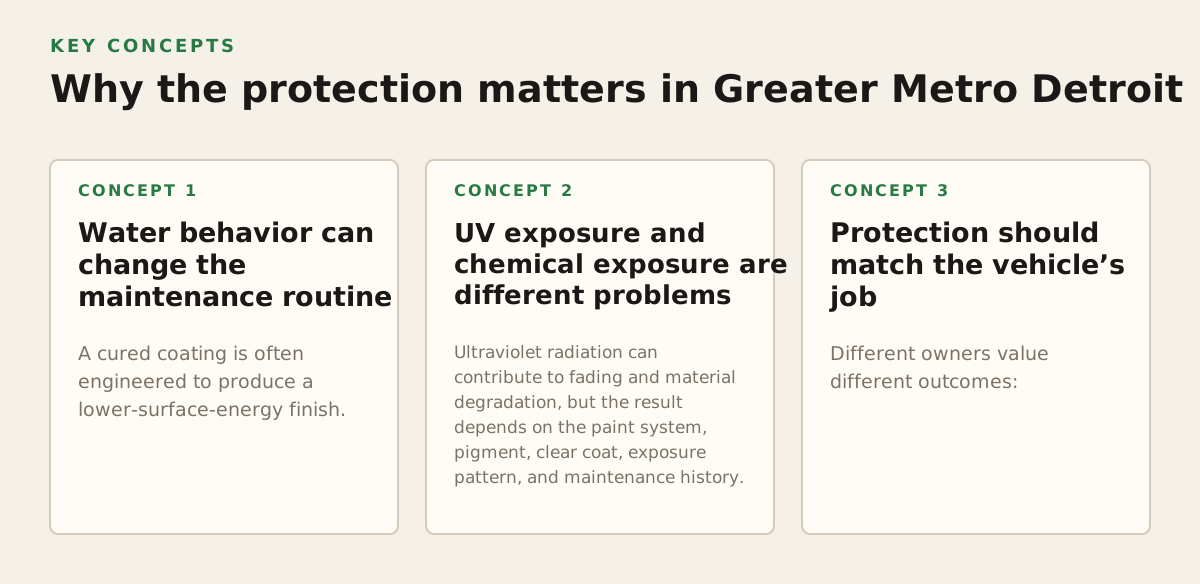
Metro Detroit vehicles experience a mixture of contamination that changes by season and use. Winter road salt, brine, slush, grit, and repeated freeze-thaw cycles can leave residue on lower panels and in crevices. Spring pollen and construction dust may combine with moisture. Summer sun, bird residue, insects, and hard-water deposits create different cleaning problems. A coating does not stop these materials from landing on a vehicle, but its altered surface behavior can make prompt removal more manageable.
Water behavior can change the maintenance routine
A cured coating is often engineered to produce a lower-surface-energy finish. Water may bead, sheet, or release dirt differently than it does from unprotected paint. That behavior is useful because contamination that is less strongly attached can be removed with less aggressive agitation. It is not proof that the surface is self-cleaning. A dirty vehicle can still collect a film of traffic residue even when water beads dramatically.
Easy rinsing is a maintenance advantage, not a license to delay washing. Mineral-rich water can leave deposits as it evaporates, and bird droppings or insect residue can etch paint if they remain exposed to heat and moisture. The coating may reduce the effort required to clean the surface, but it does not eliminate the need for timely care.
UV exposure and chemical exposure are different problems
Ultraviolet radiation can contribute to fading and material degradation, but the result depends on the paint system, pigment, clear coat, exposure pattern, and maintenance history. NOAA explains that UV exposure varies with factors including solar angle, altitude, cloud cover, and reflective surfaces in its UV radiation educational resource. A coating can be part of a paint-care strategy, yet it should not be described as an absolute UV shield.
Likewise, a coating may help reduce direct contact between paint and some contaminants, but chemical resistance has limits. Strong cleaners, prolonged exposure to alkaline or acidic substances, solvents, and neglected deposits can affect the coating or the surface beneath it. The correct maintenance chemical depends on the coating manufacturer’s instructions and the contamination being removed.
Protection should match the vehicle’s job
Different owners value different outcomes:
- Daily commuters may prioritize easier washing and a finish that stays presentable through winter grime.
- Truck owners may want the painted cab and bed sides easier to clean while using a tougher strategy for high-impact front-end areas.
- Sports car owners may place greater value on gloss, defect reduction, and careful cosmetic preparation.
- Motorcycle, dirt-bike, and ATV owners need a plan that accounts for mud, plastics, tight hardware, and transport dust.
- Boat and jet-ski owners must distinguish painted or gel-coated surfaces from upholstery, nonskid decking, glass, and hardware.
- RV, bus, semi, and fleet operators need consistent cleaning procedures that reduce downtime without promising that one product suits every substrate.
For a vehicle that regularly encounters gravel, highway debris, or close-following traffic, a coating alone may leave the owner disappointed. In those impact zones, ppf may be the more appropriate protective layer, sometimes combined with coating on uncovered painted areas.
How a ceramic coating works after installation
The useful mechanism is not magic or a permanent force field. It is a combination of surface chemistry, film formation, and maintenance behavior. The installer spreads a liquid product across a prepared panel. The product levels and begins to react. At the correct point, the installer removes excess material before it cures unevenly. The remaining film then continues curing according to the product’s requirements.
Bonding depends on a clean, compatible surface
For a coating to form a consistent film, the surface must be free of residues that interfere with contact. Polishing oils, waxes, silicone-rich dressings, moisture, dust, and incompatible previous products can create uneven bonding or visual defects. This is why a quick wash followed by immediate application is not automatically equivalent to a prepared installation.
Paint condition also affects the decision. A clear coat that is thin, failing, or heavily oxidized may not be a good candidate for aggressive correction. Deep defects can be reduced only until further polishing would remove too much material or expose a repair edge. Correction is a trade-off between appearance and remaining paint, not a contest to remove every mark.
Curing is a controlled transition, not an instant finish
During application, the installer must manage the product’s flash or leveling stage. Wiping too soon may remove too much product; wiping too late may leave high spots or streaks that require correction. Temperature, humidity, panel temperature, and airflow can change the working window. Because formulas differ, the product’s technical documentation should control the installation procedure rather than a generic internet timetable.
The vehicle also needs protection from avoidable contamination during the early cure period. Exact instructions vary, so an owner should receive written guidance covering water exposure, washing, bird residue, dust, and the use of detergents. A claim such as “fully cured in one day” is not meaningful without identifying the product, conditions, and manufacturer’s definition of cure.
Hydrophobic behavior is not the same as hardness
Beading is visually obvious, which makes it a popular way to judge a coating. It is not a complete measure of durability. A surface can bead water while carrying traffic film, and a coating can lose some beading while still providing a useful film. Conversely, strong beading does not mean a surface will resist a key, a shopping cart, or a stone chip.
Use these terms precisely:
- Hydrophobic behavior: water tends to bead or release differently from a high-energy surface.
- Gloss enhancement: the finish may appear clearer or more reflective after preparation and application.
- Chemical resistance: the film may tolerate certain exposures better than unprotected paint, within product limits.
- Scratch resistance: a limited resistance claim that should never be interpreted as scratch-proof protection.
- Impact protection: protection against physical strikes, where film thickness and material properties become more important.
For context, paint protection film is specifically sold as a film intended for vehicle paint protection, while a ceramic coating is generally a liquid-applied cured layer. The distinction is reflected in 3M’s official paint protection film product category. Selecting between them should begin with the threat—contamination, washing effort, appearance, or impact—not with whichever label sounds hardest.
Where ceramic coating breaks down or disappoints
The most common disappointment is a mismatch between the owner’s expectation and the coating’s job. If someone expects an unwashed vehicle to stay clean, road salt to disappear, or stone chips to stop, the service has been sold as something it cannot be. A coating improves a maintenance system; it does not replace one.
It will not stop common physical damage
Coatings do not reliably prevent:
- Rock chips and deep impact marks.
- Door dings, dents, and creases.
- Key scratches or deliberate vandalism.
- Damage from dragging equipment, branches, or cargo.
- Clear-coat failure that already exists.
- Rust that has begun beneath a damaged edge or panel.
On a commuter car that spends hours on I-75 or US-23, the front bumper and hood may face a different threat than the doors. On a work truck, the bed rails and loading areas may see more abuse than the roof. On a motorcycle or ATV, transport straps, branches, mud, and mechanical handling can cause damage that a coating is not designed to absorb.
Bad washing can still create defects
A coated vehicle can be swirled by dirty wash media, automatic brushes, contaminated drying towels, or aggressive wiping of dry dust. Water spots can remain if water is allowed to evaporate on a hot panel. Salt and grit can be dragged across the finish if the owner wipes without first rinsing.
A sensible maintenance routine usually includes:
- Rinse loose grit before making contact with the paint.
- Use clean wash media and a vehicle-safe shampoo approved or tolerated by the coating manufacturer.
- Work in manageable sections rather than allowing soap to dry.
- Rinse thoroughly, including emblems, trim gaps, wheel arches, and lower panels.
- Dry with clean, suitable towels or an appropriate air-drying method.
- Remove bird residue, insect remains, and tree material as soon as practical without grinding them into the surface.
For a fleet or dealership, the procedure must be repeatable. A coating applied to ten vehicles but maintained with inconsistent brushes, towels, and chemicals will not deliver consistent appearance. The process owner should document the wash method and identify which products are permitted.
Salt and corrosion require more than paint protection
Road salt is a corrosion concern because dissolved salt increases the ability of water to carry electrical current, helping corrosion reactions occur on exposed metal. The U.S. Geological Survey discusses the relationship between road salt and water quality in its road salt and water quality resource. A ceramic coating on painted bodywork does not replace underbody rinsing, inspection, rustproofing, or undercoating where those services are appropriate.
After a winter drive, a useful priority is to remove salt from wheel wells, suspension-adjacent areas, rocker panels, door jambs, and underbody surfaces where practical. Paint protection and corrosion prevention overlap, but they are not interchangeable services.
Illustrative examples clarify the boundary
The following numbers are illustrative planning examples, not universal performance benchmarks:
- A personal vehicle washed every 2 weeks during a 12-week winter period represents approximately 6 planned washes; delaying all winter cleaning because the vehicle is coated defeats the maintenance benefit.
- A fleet manager scheduling a 20-vehicle inspection can divide the group into 4 batches of 5 vehicles so condition checks and wash procedures are easier to control; this is an operational example, not a required capacity.
- An owner who protects the first 24 inches of a front bumper with an impact-oriented product is addressing a defined zone, not proving that the rest of the coating is chip-proof.
How practitioners choose and apply the right service
A sound recommendation begins with an inspection and a use case. The same dark SUV can need a different plan from a lightly used collector car, a contractor’s pickup, or a dealership trade-in. The owner should describe where the vehicle is stored, how it is washed, how many miles it travels, and what damage is already present.
Start with the surface and the threat
Use a decision sequence like this:
- Inspect the paint: look for oxidation, previous repairs, scratches, water spots, and clear-coat failure.
- Identify exposure: commuting, highway mileage, winter storage, gravel roads, commercial use, saltwater proximity, or frequent transport.
- Rank the desired outcome: easier cleaning, gloss, defect reduction, chemical resistance, impact protection, or reduced downtime.
- Choose the protection type: coating, paint protection film, correction without coating, or a combination.
- Set the maintenance plan: decide who will wash the vehicle, with what equipment, and at what frequency.
For a new SUV with clean paint and a careful owner, a coating may be a logical way to support easier routine washing. For an older black sedan covered in defects, correction and realistic expectations may matter more than the coating label. For a sports car that sees highway driving, combining coating with film on vulnerable forward-facing areas may make more sense than applying coating alone.
Use a written scope instead of a vague promise
Before approving work, ask for the scope in plain language:
- Which exterior surfaces are included?
- Will wheels, glass, trim, plastics, or exhaust components receive a separate product?
- What level of paint correction is proposed?
- Which defects will remain because removing them would risk the clear coat?
- What product is being installed, and what preparation does its manufacturer require?
- How long must the vehicle remain protected from water or contamination?
- Which soaps, toppers, and decontamination methods are compatible afterward?
- What inspection or maintenance recommendations apply to commercial vehicles and larger equipment?
These questions are especially important for boats, RVs, motorcycles, buses, semis, and commercial vehicles because they combine multiple materials and access challenges. Painted metal, gel coat, plastics, glass, rubber, vinyl, and powder-coated components should not automatically receive the same chemical treatment.
Maintenance should be designed before installation
A coating makes the most sense when the owner can follow the care instructions. A person using a coin-operated wash bay may need a different plan from someone with a private wash area. A dealership may need a repeatable hand-wash and inspection process. A fleet manager may prefer a documented product list so drivers do not apply incompatible cleaners at different locations.
Do not judge success only by the first dramatic water-beading demonstration. Better measures include whether routine washing takes less effort, whether contamination can be removed without aggressive scrubbing, whether the finish remains visually consistent, and whether the owner can maintain the vehicle without undermining the film.
A practical recommendation for 2026 vehicle owners
Choose ceramic coating auto detailing when your main objectives are improved cleanability, a refined appearance, and added resistance to ordinary environmental contamination—and when you are prepared to maintain the vehicle correctly. Do not choose it as a substitute for paint correction, rust prevention, impact film, safe washing, or body repair.
For a Greater Metro Detroit vehicle, the most defensible plan is to match protection to exposure: prepare the paint honestly, use coating where contamination and maintenance are the primary concerns, consider film for impact-prone areas, and address winter corrosion with appropriate underside care. A consultation should end with a defined scope, known limitations, aftercare instructions, and a recommendation tied to the vehicle’s actual use rather than a generic package name.
Rite-Way Auto Reconditioning provides detailing, paint correction, ceramic coatings, Icon Rocklear paint protection, window tinting, rustproofing, and undercoating for personal vehicles, dealerships, fleets, and specialty vehicles throughout Greater Metro Detroit. For a vehicle-specific recommendation, start with Rite-Way Auto Reconditioning and ask which combination of preparation, coating, film, and maintenance best fits its exposure.