Ceramic paint protection is a professionally prepared, liquid-applied protective coating that bonds to a vehicle’s finish and leaves a thin, slick, chemically resistant surface. It can make washing easier, reduce the way dirt and water cling to paint, and help preserve gloss. It is not a force field, a replacement for paint repair, or a substitute for washing. For a Metro Detroit car, truck, motorcycle, boat, RV, or fleet vehicle, the useful question is not whether a coating is “permanent.” The useful question is whether its benefits match the vehicle’s exposure, storage, maintenance routine, and existing paint condition.
What Ceramic Paint Protection actually is
A ceramic coating is a liquid formulation made from reactive materials that cure into a tightly bonded film over prepared paint, clear coat, gelcoat, or other compatible surfaces. Once cured, the coating changes the surface behavior of the substrate underneath it. Water tends to form beads or sheets differently, contaminants may release more readily during a proper wash, and the finish can gain a more uniform gloss.
The word ceramic can be misleading. It does not mean the vehicle receives a thick ceramic shell like a tile or laboratory component. The applied layer is thin. Its value comes from its chemical bonding, surface energy, and resistance characteristics—not from being thick enough to stop every object that touches the vehicle.
Coating versus wax and sealant
Wax, synthetic sealants, and ceramic coatings all sit between the environment and the original finish, but they do not behave identically. A wax is generally easier to apply and remove. A sealant may offer longer-lasting surface protection than a traditional wax. A professionally installed coating is intended to bond more tenaciously and provide a more durable surface-treatment approach, provided the paint is properly prepared and the coating is maintained.
- Wax: useful for short-term gloss and water behavior when frequent reapplication is acceptable.
- Paint sealant: a practical middle option for owners who want easier maintenance without a formal coating process.
- Ceramic coating: suited to owners prioritizing slickness, easier cleaning, gloss retention, and a more durable bonded layer.
- Paint protection film: a physical film designed for impact-prone areas where thickness and sacrificial protection matter more than surface slickness alone.
The distinction matters for a new truck used on gravel roads, a sports car stored indoors, and a dealership fleet that is washed repeatedly. They may all benefit from cleaner, better-protected finishes, but the appropriate system and preparation will differ.
A coating also does not correct defects by itself. Swirls, oxidation, water spotting, sanding marks, and previous chemical stains remain visible beneath a clear coating unless they are removed or reduced first. That is why paint preparation determines the starting appearance. Applying a premium product over neglected paint can preserve the wrong finish with greater commitment.
What the coating changes at the surface
After curing, the surface may become more hydrophobic, meaning water has less tendency to spread into a continuous film. This can make drying and routine cleaning more manageable, but water beading is not a complete measurement of protection. A vehicle can bead water and still have bonded contamination, scratches, or neglected areas.
Some product manufacturers describe their coatings as resistant to chemicals within specified conditions. Those statements should be read as product-specific guidance, not permission to leave bird droppings, road salt, fuel, tree residue, or industrial fallout on the vehicle indefinitely. Resistance slows damage; it does not eliminate exposure.
Why it matters for Metro Detroit vehicles and working equipment
Paint protection becomes more valuable when a vehicle faces repeated contamination or frequent cleaning. Greater Metro Detroit brings winter road salt, freeze-thaw cycles, slush, construction dust, pollen, rain, and summer heat. A vehicle parked outside near an industrial corridor, salt-treated roadway, marina, or active job site encounters a different burden than a garage-kept weekend coupe.
Environmental contamination is not merely cosmetic. The U.S. Environmental Protection Agency explains that acid rain can damage materials and accelerate deterioration of exposed surfaces; its 2026 overview provides the broader environmental mechanism at EPA’s explanation of acid rain. That does not prove that one coating will prevent every form of paint damage. It does support a sensible maintenance principle: reducing dwell time and cleaning contaminants before they etch or bond is preferable to trying to correct the damage later.
Different vehicles create different coating decisions
- Daily cars and SUVs: prioritize easier washing and a finish that remains presentable through commuting, school runs, and winter weather.
- Pickup trucks: consider separate treatment for painted panels, bed areas, wheels, and high-contact trim because work use can expose each surface differently.
- Sports cars: may justify intensive preparation because gloss uniformity and close-range appearance are central to the owner’s goal.
- Motorcycles, dirt bikes, and ATVs: require careful product selection around textured plastics, decals, exhaust components, controls, and areas exposed to mud.
- Boats and jet skis: need a surface assessment that distinguishes painted panels, gelcoat, vinyl, metals, and non-skid areas rather than treating the entire vessel as automotive paint.
- RVs, buses, semis, and fleets: need a repeatable wash and inspection process so the coating does not become an excuse for inconsistent maintenance.
For a commercial operator, the benefit is often operational rather than purely visual. If a surface releases road film more readily, a wash crew may spend less effort on certain cleaning stages. That is not a guaranteed labor reduction, and it depends on equipment, detergents, contamination, training, and inspection standards. A fleet manager should treat any efficiency expectation as a work-flow hypothesis to validate on the actual vehicle mix, not as an automatic return on investment.
How to judge value without chasing a universal lifespan
Coating durability varies with chemistry, application quality, exposure, wash technique, storage, and the substrate. A garage-kept sedan washed correctly may experience a different service life from a highway-driven salt-truck support vehicle. Rather than selecting a coating by an advertised duration alone, compare the cost and inconvenience of the alternatives:
- Estimate how often the vehicle is washed and whether the owner will follow the recommended method.
- Identify the areas most likely to receive chips, abrasion, or repeated contact.
- Separate the goal of easier cleaning from the goal of impact protection.
- Inspect the paint before choosing correction, coating, film, or a combination.
- Ask what inspection or maintenance is expected after installation.
For example, an illustrative starting policy for a personal SUV might be a careful wash every one to two weeks during heavy winter use, prompt removal of bird residue, and a professional inspection after the first season. That is a planning example, not a universal interval or a promise about coating life. A fleet should create its own policy around mileage, wash frequency, parking conditions, and contamination.
How ceramic coatings work from preparation through cure
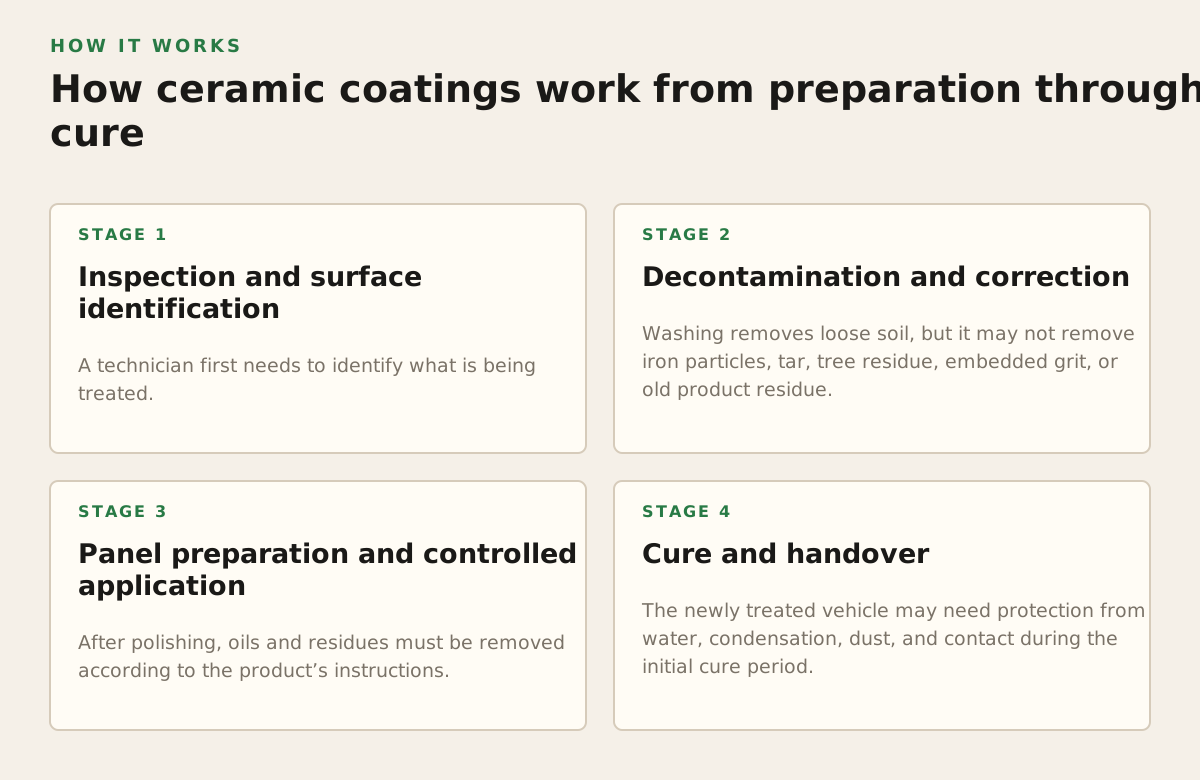
The visible result comes from a sequence of decisions. The bottle is only one part of the system. Preparation, environmental control, application technique, cure time, and later washing all affect whether the coating levels evenly and bonds to a clean surface.
1. Inspection and surface identification
A technician first needs to identify what is being treated. Automotive clear coat, single-stage paint, gelcoat, powder-coated trim, chrome, plastic, glass, and vinyl do not automatically accept the same product or preparation method. Existing repairs, repainted panels, wrapped areas, decals, and failing clear coat may change the plan.
Inspection should also document defects that a coating will not hide. A customer deciding between gloss enhancement and preservation of an original finish needs to know whether the paint is merely dirty, lightly swirled, oxidized, deeply scratched, or already delaminating.
2. Decontamination and correction
Washing removes loose soil, but it may not remove iron particles, tar, tree residue, embedded grit, or old product residue. Decontamination targets those materials with methods appropriate to the surface. Mechanical polishing can then refine gloss and reduce selected defects. It cannot restore missing paint or make a deep scratch disappear without affecting surrounding material.
This is where an honest scope of work matters. Correction changes the surface; coating preserves the prepared surface. If an owner wants maximum visual improvement, more preparation may be justified. If the vehicle is a work van with original but imperfect paint, a cleaning-focused preparation may provide better value than extensive cosmetic correction.
3. Panel preparation and controlled application
After polishing, oils and residues must be removed according to the product’s instructions. The coating is then applied in manageable sections, allowed to begin setting, and leveled or wiped at the appropriate point. Temperature, humidity, lighting, dust, and panel temperature affect how quickly the product flashes and how easily high spots can be removed.
An unevenly leveled coating can leave visible high spots, streaks, or texture. These defects are not solved by simply adding another layer. They may require correction before the coating is reapplied. This is one reason professional application should include a realistic inspection process rather than a handoff immediately after the final wipe.
4. Cure and handover
The newly treated vehicle may need protection from water, condensation, dust, and contact during the initial cure period. The exact conditions depend on the selected product. The owner should receive clear instructions covering the first wash, acceptable soaps, drying tools, automatic wash limitations, and what to do if contamination lands on the surface.
For a dealership or fleet account, the handover should be written into the operating routine. A vehicle that leaves the installer with good surface behavior can lose that benefit quickly if a wash crew uses abrasive brushes, dirty drying towels, harsh chemicals, or a contaminated bucket. Installation and maintenance are one system, even when different people perform each task.
For general vehicle-washing practices, the EPA’s 2026 nonpoint-source guidance discusses how outdoor washing can carry pollutants into stormwater systems; see EPA guidance on nonpoint-source pollution. Local rules and site conditions vary, but the practical implication is straightforward: use a controlled wash location and manage runoff responsibly rather than allowing contaminated wash water to flow unchecked.
Where Ceramic Paint Protection breaks down
A coating is a surface treatment, not structural armor. Its limitations should be decided before installation so the owner does not expect one product to solve unrelated paint problems.
Impact and abrasion
Road debris, gravel, keys, branches, loading equipment, and repeated rubbing can exceed the role of a coating. A coating may make a surface slicker and may help with cleaning after exposure, but it is not intended to absorb the same kind of impact as a sacrificial film. For leading edges, rocker panels, door cups, loading zones, and motorcycle luggage contact points, impact protection deserves a separate material decision.
Paint protection film is the more relevant category when the priority is a physical barrier against chips and abrasion. 3M describes its paint protection film as a transparent film for helping protect painted automotive surfaces from hazards such as stone chips; its official product information is available at 3M’s paint protection film overview. Film still has edges, installation considerations, cleaning requirements, and coverage limits, so it should be selected by zone rather than assumed to be necessary everywhere.
Existing damage and neglected contamination
A coating does not repair clear-coat failure, fill a deep gouge with matching paint, reverse rust, or remove a water spot that has already etched into the finish. It can lock in an appearance that was not properly corrected. Heavy contamination also complicates bonding and may create uneven results.
Owners should be especially cautious with vehicles that have:
- Peeling or cloudy clear coat.
- Unstable aftermarket paint or recent bodywork.
- Deep scratches that catch a fingernail.
- Unremoved tar, overspray, industrial fallout, or heavy oxidation.
- Decals, wraps, matte finishes, or mixed materials requiring product-specific approval.
Water spots, chemicals, and maintenance neglect
Hydrophobic behavior can create visible mineral outlines when hard water dries repeatedly on the surface. Bird droppings, bug remains, tree sap, fuel, and road salt can also cause problems when left in place. The coating may increase the time available for safe removal, but it does not make contamination harmless.
Maintenance is therefore not optional. Use clean wash media, avoid dragging grit across panels, dry without allowing mineral-heavy water to evaporate repeatedly, and follow the installer’s product-specific recommendations. If the surface feels rough or stops releasing dirt normally, schedule an inspection instead of applying random chemicals or abrasive products.
Weather exposure also matters. NOAA’s 2026 National Weather Service ultraviolet radiation overview explains that UV exposure varies with factors including sun angle, altitude, clouds, and reflective surfaces; the reference is available through the National Weather Service UV resource. The practical lesson is not that a coating makes paint immune to sunlight. It is that outdoor storage, climate, and exposure should influence the protection plan and maintenance expectations.
How a practitioner should apply the decision
The best recommendation starts with the vehicle’s use rather than the product name. A shop should ask what the owner is trying to prevent, what condition the paint is in, where the vehicle is stored, and who will wash it afterward.
Choose the protection by threat
| Primary concern | More suitable starting point | Important qualification |
|---|---|---|
| Gloss, easier routine washing, and bonded surface protection | Ceramic coating after appropriate preparation | Still requires careful washing and contamination removal |
| Stone chips and repeated impact on selected painted areas | Paint protection film, often on high-risk zones | Film coverage and edge placement determine the result |
| Swirls, oxidation, or dull appearance | Detailing and paint correction before protection | Correction cannot restore missing or failing clear coat |
| Severe rust or structural corrosion concerns | Rustproofing or repair assessment | A surface coating is not a corrosion-repair program |
| High-volume vehicle turnover | A documented fleet or dealership wash-and-inspection process | Consistency may matter more than choosing the most expensive option |
For many personal vehicles, a combination can be sensible: film on the front edge or door cups, coating on the remaining painted surfaces, and separate products for glass, wheels, trim, or interiors. That is not automatically the best answer for every vehicle. A truck used on construction sites may need durable, easy-to-replace protection in loading areas. A collector car may need a preservation plan that emphasizes reversible care and controlled storage.
Questions to ask before approving the work
- What defects will be corrected, and which will remain visible?
- Which surfaces will receive the product, and which will be excluded?
- What wash method and chemicals are approved after curing?
- What areas need film because they face impact rather than contamination?
- How should the vehicle be handled if it gets wet or contaminated immediately after service?
- What inspection or maintenance appointment is recommended for this vehicle’s use?
Owners comparing service proposals should look for a specific preparation description, surface exclusions, cure instructions, and a realistic explanation of limitations. A proposal that only lists a coating brand and a promised duration leaves out the variables that most influence the outcome.
When coating is the right recommendation
Ceramic paint protection is a strong fit when the owner values a clean, glossy appearance; wants routine washing to be more manageable; can follow maintenance instructions; and understands that the coating protects the prepared surface rather than replacing repair or impact film. It can be especially practical for daily drivers, garage-kept performance cars, recreational vehicles, and boats whose owners are willing to maintain the treated surfaces correctly.
It is a weaker fit when the vehicle has failing paint, the owner expects chip resistance from a thin coating, the wash process is consistently abrasive, or the vehicle will be exposed to severe contamination without regular cleaning. In those cases, repair, paint correction, PPF, operational changes, or a combination may deserve priority.
Rite-Way Auto Reconditioning serves Greater Metro Detroit vehicle owners, dealerships, fleets, and operators of cars, trucks, boats, RVs, motorcycles, powersports vehicles, buses, and commercial equipment with detailing, paint correction, ceramic coating, and related protection services. When impact risk is the central concern, review the separate ppf option before choosing a surface coating.
For a vehicle-specific recommendation, have the paint, storage conditions, wash routine, and highest-risk areas assessed together; Rite-Way Auto Reconditioning can help identify whether coating, correction, film, or a combination is the most defensible starting plan.