Matte paint protection film is a clear polyurethane film with a low-gloss or satin surface that helps protect a vehicle’s painted panels without turning them shiny. It is most useful for factory-matte paint, satin wraps, and gloss vehicles whose owners want a uniform stealth appearance, but it does not make paint immune to rock chips, scratches, stains, or poor washing. For Greater Metro Detroit drivers, the right decision depends on the vehicle’s finish, the panels exposed to road debris, and whether the installer can match the film’s texture across the vehicle.
What Matte Paint Protection Film actually is
Paint protection film, often called PPF, is a thin, transparent layer installed over painted or finished surfaces. A matte version uses a textured or low-reflectivity top surface rather than the smooth, highly reflective surface associated with conventional clear film. The objective is twofold: reduce visible gloss and add a sacrificial barrier between the finish and everyday contamination or impact.
The word “matte” describes the film’s appearance, not a different category of vehicle protection. A matte film can still have an adhesive layer, a polyurethane body, and a topcoat designed for resistance to staining and routine abrasion. Product construction varies by manufacturer, so an installer should identify the actual film being proposed rather than treating every satin-looking product as interchangeable. For examples of how manufacturers position different PPF finishes and applications, see the official product information from XPEL STEALTH, SunTek Paint Protection Film, and LLumar automotive paint protection film.
Matte, satin, and frosted are not always identical
Automotive terminology is inconsistent. One shop may use “matte” for a visibly non-reflective finish, while another may call a similar appearance “satin” or “stealth.” The difference matters when a vehicle has factory-matte paint because even a modest mismatch can show as a patchwork of textures across adjacent panels.
Ask to see a physical sample beside the vehicle in outdoor light. Indoor LEDs can hide differences in reflectivity, texture, and color. A sample also helps reveal whether the film’s surface is too hazy, too coarse, or visibly different from the original finish. Finish matching is a fitment question, not merely a product-name question.
What the film does and does not protect
The film takes the first contact from many minor hazards, but it cannot repeal the laws of impact. A sharp object can cut through it, a severe collision can damage the panel underneath, and contamination left on the surface can still stain or etch the film. It is better understood as a replaceable protective layer than as permanent armor.
- Likely protection targets: light road grit, small stone strikes, insects, salt residue, brush contact, and some wash-related marring.
- Commonly exposed panels: front bumper, hood, fenders, mirror caps, rocker panels, door edges, and rear cargo ledges.
- Not a guarantee against: deep impact damage, vandalism, collision deformation, paint defects beneath the film, or neglected contamination.
- Finish consequence: replacing one damaged panel of film may be necessary to restore a consistent satin appearance.
Why a matte finish changes the protection decision
Gloss paint can often be polished to reduce fine defects. Factory-matte paint cannot be treated the same way because polishing selected areas changes how they scatter light. That creates a shiny spot rather than restoring the original texture. Matte paint is difficult to correct locally, which makes prevention more valuable on high-impact areas.
A clear film also changes what can be repaired. On a gloss vehicle, an installer may be able to replace a damaged film section and blend the visual result more easily. On a matte vehicle, the replacement must match the surrounding sheen and texture. The panel may remain structurally sound while still looking inconsistent if the new piece reflects light differently.
Road salt and winter contamination
Greater Metro Detroit vehicles face a seasonal combination of salt, sand, wet roads, freeze-thaw cycles, and frequent spray from traffic. These conditions do not make PPF mandatory, but they increase the value of a surface that can be cleaned without directly abrading the factory finish every time. The practical benefit is greatest where the vehicle regularly follows salt trucks, travels expressways, or accumulates gritty residue on lower panels.
Film is not a substitute for washing. Salt solution can remain around seams, emblems, wheel openings, and film edges. A protected vehicle still needs prompt rinsing when practical, particularly after winter highway travel. Protection lowers exposure to damage; maintenance controls contamination.
Appearance and resale considerations
Some owners choose a matte film to change the appearance of a gloss vehicle. That is a finish conversion as well as a protection decision. The result may be attractive, but future buyers may prefer the original gloss, and removing film from aged, repainted, or poorly bonded surfaces carries more uncertainty than removing it from clean, properly cured factory paint.
For a factory-matte vehicle, preserving the original finish may be the stronger reason to install film. For a gloss vehicle, ask whether the goal is protection, a visual change, or both. If the priority is reflective gloss rather than a stealth appearance, conventional clear PPF or a ceramic coating may better fit the desired result. A coating can make cleaning easier and add surface protection, but it does not replace a film barrier against sharp impacts.
How the film works on a vehicle
Installation is a controlled adhesion process. The vehicle is cleaned, the surface is assessed, the film is positioned with an installation solution, and the installer works liquid and air from beneath the material while conforming it around the panel. Edges, recesses, body lines, sensors, badges, and panel gaps determine whether the result looks integrated or visibly applied.
The layers and their jobs
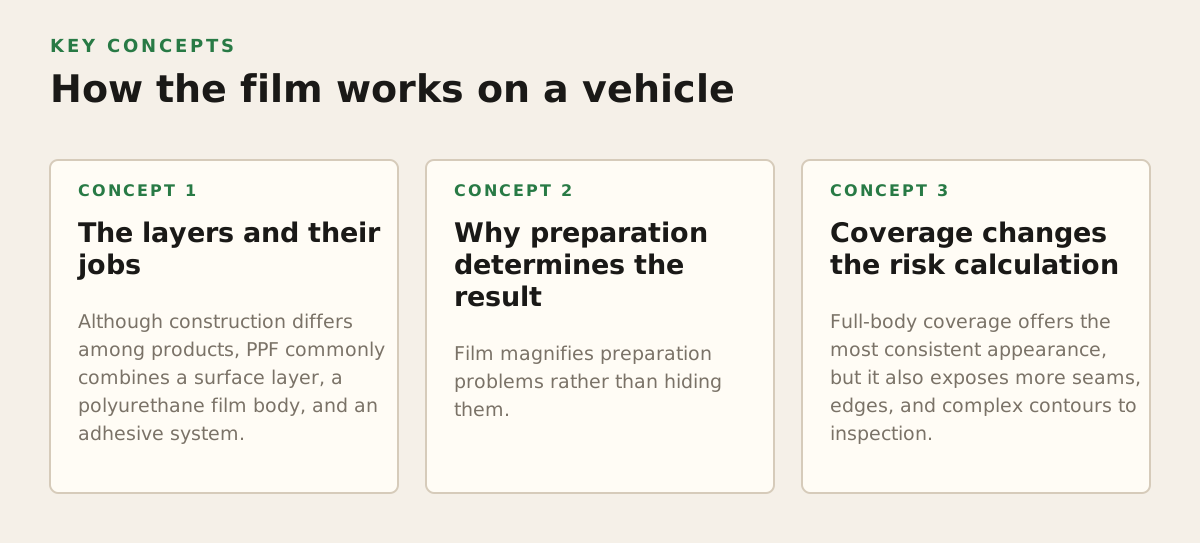
Although construction differs among products, PPF commonly combines a surface layer, a polyurethane film body, and an adhesive system. The surface affects sheen, cleanability, and resistance to environmental marking. The film body provides the physical barrier. The adhesive holds the material to the vehicle while allowing controlled placement during installation.
Manufacturers describe their products differently, so avoid turning one brand’s specification into a universal claim. The official XPEL STEALTH product page, for example, describes a matte-finish film as a product intended to alter gloss paint toward a satin appearance; manufacturer descriptions should be checked for the exact film, finish, warranty terms, and approved use being considered.
Why preparation determines the result
Film magnifies preparation problems rather than hiding them. Dust, leftover wax, embedded iron, overspray, failing clear coat, and poorly repaired paint can remain visible under the film or interfere with adhesion. On a used vehicle, the appropriate sequence may include decontamination and paint correction before installation. On factory-matte paint, correction must be approached cautiously because aggressive polishing can alter the finish permanently.
Preparation should also include a condition report. Photograph existing chips, scratches, touch-up marks, repainted panels, and clear-coat failure before work begins. PPF preserves the condition it covers; it does not erase defects already present beneath the surface.
Coverage changes the risk calculation
Full-body coverage offers the most consistent appearance, but it also exposes more seams, edges, and complex contours to inspection. Partial coverage can concentrate protection on the panels most likely to be struck while reducing material and installation complexity. Neither approach is automatically correct.
- Illustrative commuter plan: front bumper, partial hood, front fenders, and mirror caps for a vehicle that spends most of its time on paved roads.
- Illustrative highway plan: full hood, full front fenders, rocker panels, and luggage-loading areas for frequent expressway travel.
- Illustrative truck plan: bumper corners, hood leading edge, grille surround, mirror caps, door edges, and lower bedside areas exposed to gravel or job-site debris.
- Illustrative powersports plan: tank or painted shrouds, front fender areas, and contact points where boots, straps, or transported equipment can rub.
These are planning examples, not universal packages. A boat, jet ski, RV, bus, or commercial vehicle may need a different assessment because panel materials, access, graphics, operating environments, and repair practices vary. Large vehicles also make consistent finish matching more important because long uninterrupted panels show sheen differences readily.
Where matte PPF breaks down or disappoints
The most common disappointment is expecting invisible, permanent protection. Film can develop cuts, lifting, edge contamination, stains, or texture changes. It can also reveal an installation issue that was difficult to see at delivery. A proper decision includes what happens when a section is damaged, not just how the vehicle looks on installation day.
Edges, seams, and contamination
Edges are transition points where dirt can collect and where repeated pressure washing, brushes, or rubbing can create lift. Complex bumpers and recessed styling lines may require seams or carefully concealed terminations. A seam is not automatically a defect; an exposed, irregular, or contaminated seam deserves explanation.
- Inspect panel edges at normal standing height and from close range.
- Look for trapped debris, fingers, bubbles, lifting corners, and inconsistent stretch marks.
- Confirm how the shop handles badges, sensors, emblems, grilles, and removable trim.
- Ask whether a damaged section can be replaced without disturbing adjacent panels.
Cleaning and chemical limits
Matte surfaces should not be treated like polished gloss paint. Abrasive compounds, aggressive spot correction, stiff brushes, and unsuitable dressings can change the surface appearance or leave uneven sheen. The exact care instructions belong to the film manufacturer, not to a generic internet checklist. For example, SunTek publishes product and care information through its official automotive film resources, while LLumar provides product-specific information on its automotive PPF pages; request the care sheet for the exact film installed.
As a practical starting policy, wash with a clean, soft mitt, rinse grit away before contact washing, and remove bird residue or bug remains without scrubbing dry material across the surface. Do not use a polishing process on matte film unless the manufacturer specifically approves it. Uneven abrasion creates uneven sheen, which is especially visible on broad hood and door panels.
Removal and underlying paint
Removal is generally a film-service operation, not a promise that every underlying finish is risk-free. Aged film, weakened clear coat, repainted panels, and poorly bonded surfaces require more caution. If a vehicle has aftermarket paint, previous wraps, or clear-coat failure, disclose that before installation. The correct recommendation may be limited coverage, a test area, or postponement until the paint is stabilized.
How to choose an installer and coverage plan
For a Detroit-area owner, the installer’s process may matter as much as the film’s label. Look for a shop that can explain finish matching, surface preparation, pattern strategy, edge treatment, curing or post-installation instructions, and what is excluded from its workmanship policy. A polished showroom and a recognizable product name do not by themselves prove careful installation.
Questions that produce useful answers
- Which exact film and finish? Ask for the manufacturer, product name, sheen, care instructions, and warranty documentation.
- What will be corrected first? Confirm how chips, contamination, touch-up paint, repainted panels, and factory-matte surfaces will be handled.
- Which panels are included? Get coverage defined in writing, including hood width, fender extent, rocker coverage, door edges, and luggage-contact areas.
- How are patterns and edges handled? Ask whether seams, wrapped edges, sensor areas, and removable trim are part of the proposed process.
- What happens after installation? Confirm inspection timing, washing restrictions, warranty exclusions, and the process for addressing lifting or trapped debris.
For dealerships and fleet managers, add operational questions: Can the shop document each vehicle’s pre-existing damage? Can the coverage be repeated consistently across similar units? Will the finish remain visually uniform for delivery photos, lease returns, or branded commercial vehicles? Consistency and documentation often matter more than maximum coverage on one vehicle.
When partial coverage is the sensible answer
Partial coverage is often appropriate when a customer wants impact protection on the most exposed areas but does not need a fully altered appearance. It can also be a sensible first step for a new vehicle owner who wants to learn the maintenance routine before covering additional panels. The trade-off is a visible transition between protected and unprotected surfaces, especially where the film changes reflectivity or texture.
Full coverage is more compelling when the vehicle has factory-matte paint, a difficult-to-repair finish, high sentimental value, frequent highway exposure, or a uniform satin appearance is the primary goal. A truck used on gravel roads may justify protection beyond a commuter car; a motorcycle or dirt bike may need targeted coverage at contact points rather than a conventional car package.
Before requesting an estimate, take photographs of every side of the vehicle and note whether it is factory paint, repainted, wrapped, ceramic-coated, or previously filmed. Include the vehicle’s normal use: daily commuting, dealership inventory, fleet service, towing, track use, boat launching, RV travel, or powersports transport. That information lets an installer recommend coverage based on exposure instead of selling a generic menu.
A practical recommendation for Metro Detroit vehicles
Choose matte paint protection film when preserving or creating a satin appearance is important and the vehicle regularly faces road debris, winter contamination, loading contact, or difficult-to-repair matte paint. Start with an inspection and a finish sample, then decide between targeted high-impact panels and full coverage. Do not approve the job until the installer explains the exact film, preparation, edges, maintenance, and replacement process.
For a gloss vehicle where appearance preservation matters more than changing the finish, compare conventional ppf with a coating rather than assuming matte film is the better protection. For trucks, motorcycles, boats, RVs, powersports equipment, dealerships, and fleets, tailor the coverage to contact points and operating conditions. Rite-Way Auto Reconditioning serves Greater Metro Detroit with paint protection film, detailing, paint correction, coatings, tinting, rustproofing, and undercoating; use Rite-Way Auto Reconditioning to discuss the vehicle and the protection plan before choosing a finish.