Exterior detailing typically means washing the vehicle’s exterior, cleaning its wheels and tires, and drying the surfaces. Depending on the provider and vehicle, residue removal, paint correction, and protection may be separate options rather than standard inclusions. This guide helps Greater Metro Detroit drivers, specialty-vehicle owners, and fleet or dealership managers compare the actual tasks in a service—not just its package name—and choose work that fits the vehicle’s condition and intended use.
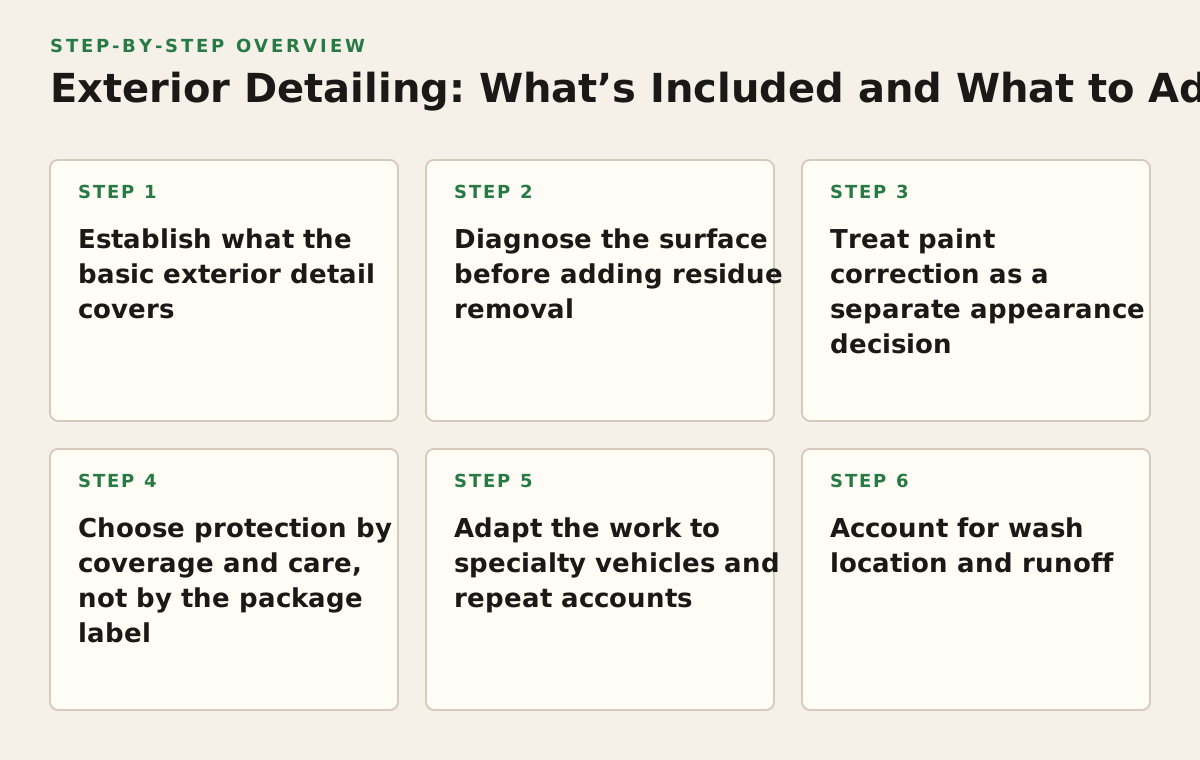
1. Establish what the basic exterior detail covers
When it applies: Start here when comparing quotes or booking a routine clean. A typical exterior detail focuses on removing surface soil and improving the vehicle’s clean appearance. Common tasks include washing the painted exterior and glass, cleaning wheel faces and tires, and drying exterior surfaces. The provider’s scope may include more, but the label “exterior detail” does not establish that.
Why it works: Separating the basic clean from add-ons makes quotes easier to compare. It also prevents an ordinary wash from being confused with work intended to change the finish or add protection. For example, a clean vehicle can still have bonded residue, swirl marks, or no protective product; those are different conditions and may call for different services.
Turn the package name into a task list
- Confirm which exterior surfaces are included: painted panels, glass, trim, and other relevant materials.
- Ask whether wheel and tire cleaning is included and what “wheels” covers, such as faces or accessible inner areas.
- Confirm that drying is part of the service and ask whether any other finishing step is included.
- Separate optional residue removal, polishing, and protection from the basic cleaning scope.
Failure mode: Assuming that “full detail” means a wash plus correction and protection. It may not. As an illustrative example, a dealership comparing reconditioning options could request a written list of tasks for each package, then compare like with like instead of relying on package names.
2. Diagnose the surface before adding residue removal
When it applies: Ask about a separate assessment if a panel still feels rough after washing, or if visible spots or residue remain. A wash is aimed at surface soil; material that remains bonded may call for a different removal method. The suitable approach depends on the material, the surface, and any existing finish treatment.
Why it works: A clear diagnosis helps distinguish contamination from paint defects. Roughness, a water spot, and a scratch can look or feel like “a paint problem,” but they are not interchangeable. A detailer who identifies the affected area and explains the proposed step gives you a more useful basis for approval than a broad promise to “deep clean” the paint.
Minerals in water can affect its hardness; the USGS describes hardness in relation to dissolved minerals such as calcium and magnesium in its water-hardness overview. That background does not identify the cause of a particular mark on your vehicle. Describe the marks and ask for an assessment rather than assuming they will wash away or require polishing.
Make the concern specific
- Point to the affected panel or component and describe whether the issue is visible, tactile, or both.
- Share clear photos if you are requesting an initial estimate, while recognizing that a photo may not reveal surface texture or treatment history.
- Ask what material or condition the proposed residue-removal step is meant to address.
- Mention existing coatings, film, or unusual finishes before agreeing to a method.
Failure mode: Authorizing an aggressive step because one area feels rough, without asking what is on it or how the method relates to the existing finish. For example, if a clean hood still feels rough, ask whether the assessment and any added work can be limited to the affected area rather than automatically applied to every panel.
3. Treat paint correction as a separate appearance decision
When it applies: Consider paint correction when visible swirls, other paint defects, or reduced gloss matter to you—not simply because the vehicle needs washing. Correction involves polishing the finish to reduce the appearance of certain defects. The achievable result depends on the paint’s condition and the proposed process; not every mark is suitable for removal.
Why it works: Agreeing on the target before polishing makes the work and its limitations clearer. Ask which defects are being addressed, whether the provider will assess the paint first, and what improvement is realistic. A specific goal such as improving overall gloss or reducing the appearance of marks on selected panels is more useful than asking for a “perfect” finish.
Set a realistic correction scope
For a sports car with noticeable wash marks, identify the panels that matter most and ask what level of correction is proposed. For a work truck with minor marks, washing may meet the practical goal without adding polishing. If a provider proposes correction before applying protection, confirm whether it is part of the same quote or a separate task.
Failure mode: Expecting every scratch or spot to disappear. Some defects may remain because of their depth, location, or the limits of the proposed process. Before authorizing correction, ask what may be left behind and whether the goal is improvement rather than complete removal. Correction is not a cleaning step, and a protective product is not a substitute for it.
4. Choose protection by coverage and care, not by the package label
When it applies: Discuss protection if you want more than a clean exterior and are prepared to understand its coverage and maintenance. A coating and paint protection film are distinct options, not automatic parts of an exterior detail. For film, XPEL provides product information about its paint protection film; that does not determine which product or coverage is right for a particular vehicle.
Why it works: Protection decisions become more concrete when you connect the option to the areas and use that matter. A sports-car owner might ask about selected panels; a fleet manager might first consider whether product-specific care fits the existing washing routine. The intended coverage, surface preparation, and aftercare should be discussed for the actual option under consideration.
If film is installed, its care instructions can be product-specific. XPEL’s paint protection film care guidance is an example of manufacturer information to consult for that film. Do not assume those instructions apply to every film, coating, or finish; ask for guidance that matches the product on the vehicle.
Clarify the proposal before approving it
- Ask what product or type of protection is proposed and which areas it covers.
- Confirm what preparation is included and whether paint correction is separate.
- Request care instructions for the specific installed product.
- For boats, RVs, motorcycles, or powersports vehicles, ask which materials and components are included rather than assuming an automotive paint process fits every surface.
Failure mode: Approving a general promise of “protection” without knowing coverage or maintenance expectations. For example, before considering film on a sports car, ask which panels are proposed and what preparation and aftercare apply. Rite-Way’s pages provide further information on its coating and ppf offerings; confirm the proposed scope for your vehicle before deciding.
5. Adapt the work to specialty vehicles and repeat accounts
When it applies: A standard passenger-car description may be too vague for a motorcycle, boat, jet ski, RV, bus, semi, or commercial vehicle. These vehicles can have different combinations of painted, coated, plastic, metal, glass, or other surfaces, along with different access constraints. Dealerships and fleet managers also need to know whether a quoted scope can be applied consistently across similar units.
Why it works: Naming the vehicle, surfaces, and access concerns helps the provider define what can actually be cleaned. “Exterior” might mean painted panels and glass on one vehicle, but require a more careful list of components on another. For a fleet, a repeatable task list can make exceptions visible: a vehicle with a specialty finish should not silently receive a process intended for a different surface.
Build a vehicle-specific scope
- Identify the vehicle type and the components you want addressed.
- Flag aftermarket parts, unusual finishes, existing treatments, or areas that are difficult to reach.
- Ask whether access limits or excluded areas will be noted in the quote.
- For dealership or fleet work, document the common scope and identify vehicles that need separate assessment.
Failure mode: Treating a large vehicle or a fleet as a passenger car multiplied several times. For example, a fleet coordinator could list the common exterior tasks, then flag a bus or work vehicle with unusual materials for separate review. This keeps the repeatable part of the job clear without assuming every unit has the same needs.
6. Account for wash location and runoff
When it applies: Consider location and drainage before arranging a wash at home, at a business, or for multiple fleet vehicles. Wash water can carry soil and cleaning products away from the work area. The EPA’s stormwater program information explains the broader concern about pollutants entering stormwater systems. Applicable requirements depend on the location and circumstances, so this overview is not a substitute for checking local rules.
Why it works: Deciding where the work can take place before scheduling helps avoid a mismatch between the planned wash and the site’s drainage or operating constraints. For a business, that means checking the approved wash area and procedure; for an individual vehicle owner, it means not assuming every driveway or lot is suitable.
Failure mode: Treating a convenient location as automatically appropriate. As an illustrative starting policy for a fleet, identify an approved wash location and confirm its runoff procedure before scheduling repeat cleaning. Check local requirements and site rules rather than treating that example as a universal standard.
| Observed condition or goal | Scope to discuss | Decision question |
|---|---|---|
| Dust, loose dirt, or road film | Wash, wheel and tire cleaning, and drying | Which surfaces and wheel areas are included? |
| Roughness or residue after washing | Assessment and, if appropriate, residue removal | What is being treated, and which method is proposed? |
| Swirls or reduced gloss | Paint assessment and possible correction | Which defects are targeted, and what may remain? |
| Interest in longer-term surface protection | Discuss a coating or film separately from cleaning | What areas are covered, what preparation is included, and what care is required? |
| Specialty vehicle or fleet | Vehicle-specific scope and access review | Which materials, components, and exceptions are included? |
Use this sequence to select and authorize the work
A short written brief turns a general request into a scope that can be checked. Use the sequence below before approving optional tasks:
- Identify the vehicle and surfaces. Name the car, truck, motorcycle, boat, RV, or fleet group, then list the exterior areas you want addressed.
- Describe the condition. Separate ordinary soil from roughness, spots, visible paint defects, or an interest in protection. Photos can help communicate visible concerns but may not show surface texture or treatment history.
- Request the basic task list. Confirm washing, wheel and tire cleaning, drying, and any included surfaces. Ask the provider to define broad package terms in the quote.
- Approve add-ons by purpose. For residue removal, ask what is being treated. For correction, agree on target defects and limits. For protection, confirm coverage, preparation, and product-specific aftercare.
- Flag constraints. Mention existing treatments, specialty materials, access issues, and wash-location requirements that may affect the work.
- Compare written scopes. Choose the tasks that fit the vehicle’s condition and your intended result. For dealership and fleet work, record the agreed common scope and note exceptions rather than assuming every vehicle is identical.
Rite-Way Auto Reconditioning provides exterior detailing, paint correction, coatings, paint protection film, and detailing for vehicles including RVs, boats, and powersports equipment. To discuss a scope for your vehicle or fleet, contact Rite-Way Auto Reconditioning.