
A fleet vehicle reconditioning quote template should identify each unit, record observable condition, separate proposed services and costs, and state how approvals and scope changes will work. Use the worksheet below to request comparable estimates for dealership inventory or fleet vehicles, then decide which items serve the stated goal and which remain optional.
Want it done for you? See our auto detailing service at our Romeo shop, or call (586) 651-4007.
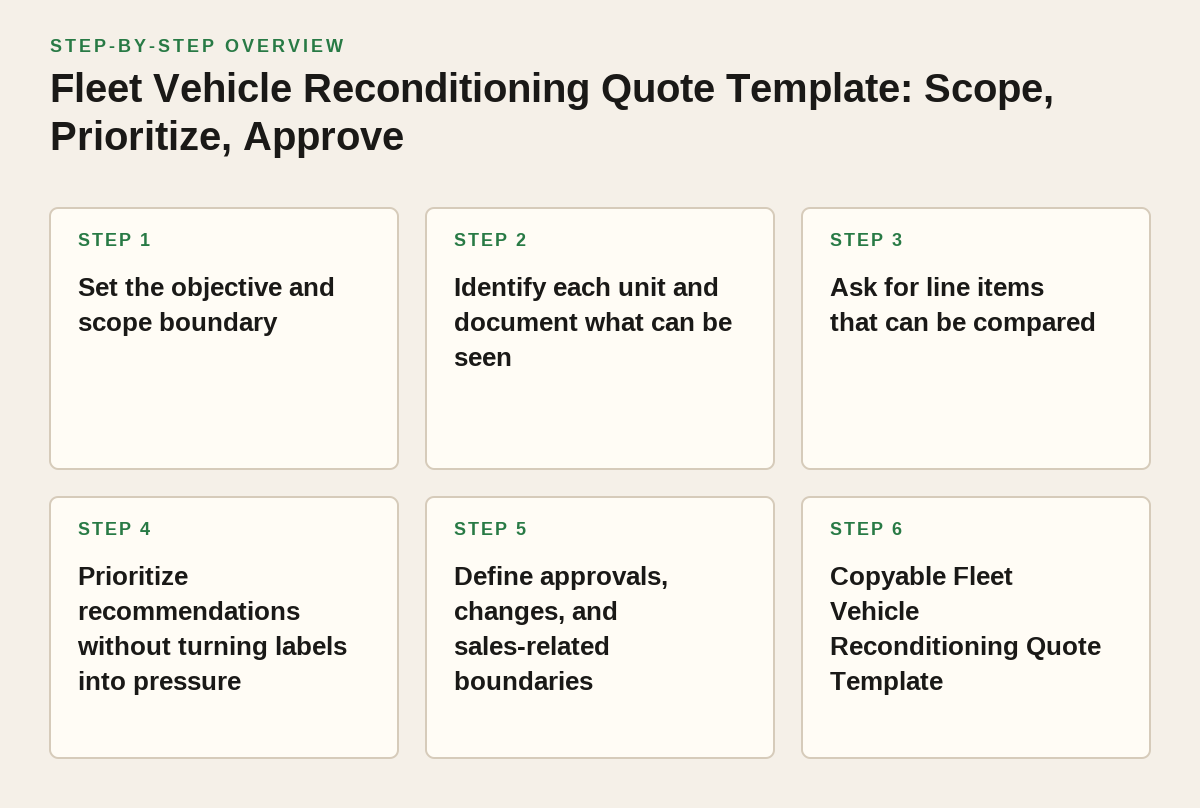
1. Set the objective and scope boundary
Use this step when vehicles are being prepared for different purposes, such as resale, return to service, or appearance maintenance. The objective gives an estimator context for recommendations and helps an approver judge whether each proposed item belongs in the job. A request such as “prepare these units for resale” is more useful than “make them look good,” because it identifies the decision the work should support.
A common failure is mixing cosmetic work with unrelated repairs or assuming every unit needs the same treatment. For example, a dealership may ask for exterior and interior reconditioning on returned SUVs while excluding mechanical and glass work. That boundary makes it clearer what the estimate covers, and what must be handled separately.
Write down the decision context
- Purpose: resale preparation, return to regular use, or a stated appearance standard.
- Units included: identify the group and note whether each vehicle has the same target condition.
- Exclusions: identify work outside the request, such as mechanical repair or glass replacement.
- Constraints: note any access, equipment, or scheduling details that the estimator needs to confirm.
Keep these statements practical. “Prepare unit 214 for resale; assess visible interior and exterior concerns; exclude mechanical repairs” gives a provider a defined assignment without implying that every visible issue has a known repair method.
2. Identify each unit and document what can be seen
Use one record per vehicle whenever units differ in model, configuration, or condition. A group description such as “six trucks” can conceal differences that change the work. Include a fleet or stock ID, year, make, model, VIN, and odometer reading when available. NHTSA’s VIN decoder can help identify vehicle details from a VIN; verify the result against the vehicle and fleet records, since decoding does not document its current condition.
Condition notes matter most when the person approving the estimate did not inspect the vehicle. Describe the location and visible issue rather than guessing at its cause or promising a result. “Stain on the driver-seat cushion” is more actionable than “bad interior.” A failure mode is using only a subjective grade such as “fair,” which can mean different things to an estimator and an approver.
Make observations repeatable
- Use consistent zones: front, left side, rear, right side, roof, cabin, and cargo area.
- Record the visible type and location of an issue: scratch, residue, stain, odor, or worn surface.
- Attach clear photos to the vehicle record and label them so they can be matched to the unit.
- Mark areas that could not be inspected or need an in-person assessment.
For example, write “visible scratches on hood; depth and repairability to be assessed” rather than “hood needs paint correction.” The first records an observation and leaves the method open for evaluation; the second presumes a solution before the surface has been assessed.
For commercial motor vehicles subject to federal requirements, keep a cosmetic reconditioning estimate separate from required maintenance records. The regulation at 49 CFR § 396.3 addresses systematic inspection, repair, and maintenance for covered vehicles and related records. Confirm which requirements apply to your operation; a reconditioning quote does not replace that process.
3. Ask for line items that can be compared
Request separate line items when an approver might accept one service and decline another, or when the same group includes units with different needs. Each line should connect a vehicle to the proposed work and its reason. Where practical, ask for the area or quantity covered, the amount, and any assumptions or exclusions.
Bundled pricing is not automatically unclear, but a single total without a scope description makes comparison difficult. One estimate might include interior work while another covers only the exterior. For instance, listing interior reconditioning and exterior detailing separately lets a buyer compare those scopes before considering paint correction or a protective finish.
Separate known work from assessment-dependent work
- Ask the provider to identify work that can be quoted from the supplied information.
- Mark items that depend on inspection or additional assessment.
- Request the proposed method and any stated limitations for finish-related work.
- Keep optional services distinct from the subtotal for the requested scope.
If paint protection is under consideration, treat the specific service as a separate decision, not an assumed part of cleaning. Rite-Way’s information about coating and ppf can help identify those service categories; the estimate should still state which surfaces and preparation are proposed for the particular vehicle. For example, a resale unit might have interior and exterior work listed separately, with paint correction and a protective treatment shown as separate options.
4. Prioritize recommendations without turning labels into pressure
Use priority categories when a fleet budget is limited or several people need to review the same estimate. Categories such as “required for the stated objective,” “recommended,” and “optional” can make the decision easier, provided each label comes with a reason. These are buyer-side decision aids, not technical diagnoses: the estimator should explain the recommendation, and the approver decides whether it fits the objective.
A failure mode is calling an item “required” without explaining what it is required for, or putting optional appearance work into the requested-work subtotal. For a vehicle being prepared for resale, an interior concern may be recommended because it affects presentation, while an additional protective finish remains optional. The quote should show that distinction rather than burying it in a package price.
Use a consistent review test
- Objective fit: Does the item address the stated purpose for this unit?
- Evidence: Is there an observation or assessment supporting the recommendation?
- Choice: Can the approver accept or decline the item without obscuring other costs?
Apply the same questions across all units. If two vehicles have similar recommendations but different observations, preserve the difference in their records rather than copying one vehicle’s scope across the batch.
5. Define approvals, changes, and sales-related boundaries
Set approval rules before work begins, especially when the estimate may change after a vehicle is inspected. Identify who can authorize added work, whether approval must be written, and how the provider should present a change. Without this control, a manager may receive a revised total without a clear record of what changed or who approved it.
A useful request is: “Do not proceed with work outside the approved scope until the named approver confirms it in writing.” The estimate should also say how inspection findings will be reported. For example, if a surface concern needs further assessment, ask for the finding, proposed next step, and revised cost to be sent for review rather than treating the additional work as already authorized.
If a dealership is preparing a vehicle for retail sale, keep sales disclosures distinct from reconditioning scope. The FTC’s Used Car Rule covers dealer obligations involving the Buyers Guide; the quote itself should not imply that it handles those obligations. The FTC also provides Buyers Guide information for dealers. Confirm the dealership’s sales documentation process separately from approval of reconditioning work.
6. Copyable Fleet Vehicle Reconditioning Quote Template
Copy this worksheet into a document or spreadsheet. Use a separate vehicle record for each unit, and have the estimator complete the quote fields. If a fact is not known yet, mark it “to confirm” instead of leaving a blank that could change the scope.
| Prompt / question | Your answer / input |
|---|---|
| Who is requesting the quote, and who can approve the work? | [Company / contact / approver] |
| What is the objective, and what work is outside the request? | [Purpose / exclusions] |
| Which vehicle is this? Include fleet ID, year, make, model, VIN, and odometer if available. | [One complete vehicle record] |
| What condition issues are visible, where are they, and which photos show them? | [Observation / location / photo reference] |
| What work is proposed for this unit, and why? | [Separate service / reason / area] |
| Is the item required for the objective, recommended, or optional? Why? | [Category / explanation] |
| What is the amount for each line, and what assumptions or exclusions apply? | [Line amount / assumptions / exclusions] |
| What needs further assessment before a scope or amount can be confirmed? | [Item / next step / to confirm] |
| Who must approve additional work, and how will approval be recorded? | [Approver / written method] |
| What vehicle handoff, access, or completion details still need confirmation? | [Details to confirm with provider] |
Worked example: one returned pickup
Illustrative example only; this is not a quote or a finding about a particular vehicle. A fleet manager records a pickup’s fleet ID, VIN, odometer reading, and photos. The objective is “prepare for resale,” with mechanical and glass work excluded. The condition record notes staining on the driver-seat cushion and visible scratches on the hood. The estimator lists interior reconditioning and exterior detailing separately, and marks the hood as needing assessment before a paint method can be proposed. A protective finish appears as an optional line. The manager can review the presentation work without treating either the unassessed paint issue or the optional finish as approved.
Adapt the worksheet only where your approval process needs additional information, such as an internal cost center or purchase-order reference. Keep the core fields, vehicle identity, observable condition, itemized scope, cost, and approval, so the estimate remains traceable from request to decision.
7. Put the quote process into operation
Use the same sequence for one vehicle or a batch. It resolves identity and scope before anyone compares totals, and it leaves a record of which work was authorized.
- Assemble the unit list. Match fleet or stock IDs to vehicle details, and flag missing information for follow-up.
- Group by objective. Separate sale preparation from routine appearance maintenance when those goals call for different decisions.
- Record condition. Use consistent zones, attach labeled photos, and note areas that could not be inspected.
- Request itemized recommendations. Ask for reasons, assumptions, exclusions, and any work that needs further assessment.
- Review priorities and authority. Decide which items fit the objective and identify who can approve scope changes.
- Confirm handoff details with the provider. Resolve access and completion arrangements directly rather than treating unconfirmed details as part of the quote.
- Save the decision record. Keep the approved scope with the estimate and note declined options or authorized changes.
For fleet accounts in Greater Metro Detroit, Rite-Way Auto Reconditioning provides dealership and fleet vehicle reconditioning, detailing, paint correction, ceramic coatings, paint protection film, rustproofing, and undercoating. To discuss a fleet scope or request a quote, visit Rite-Way Auto Reconditioning.