Car ceramic coating is a professionally applied liquid polymer treatment that chemically bonds, or partially bonds, with a vehicle’s prepared clear coat to create a thin, hard, water-repellent protective layer. It is not a replacement for paint protection film, a permanent shield against rock strikes, or permission to stop washing the vehicle. For a Metro Detroit car, SUV, truck, sports car, motorcycle, boat, RV, or fleet vehicle, its value comes from making the exterior easier to maintain while helping the finish resist environmental contamination and UV exposure.
What a ceramic coating actually is
The word “ceramic” can make the product sound like a thick shell. In automotive use, a ceramic coating is usually a liquid formulation containing silicon-based or other inorganic-resin chemistry. During curing, the product forms a tightly connected film over the paint surface. The exact resin, solvent system, solids content, application method, and curing requirements vary by product.
That distinction matters because a coating is measured in chemical resistance, surface behavior, and film integrity, not simply by how glossy it looks on delivery day. A showroom shine may be impressive, but gloss alone does not tell you whether the surface was properly decontaminated, whether the coating cured evenly, or whether the owner can maintain it correctly.
Coating versus wax and sealant
Traditional waxes and synthetic sealants sit on the surface and gradually wear away through washing, abrasion, weather, and chemical exposure. A ceramic coating is designed to form a more durable bonded layer. That does not make it indestructible. It still has a finite service life, and its performance depends on preparation, application thickness, curing conditions, product chemistry, and maintenance.
Think of the products as different tools:
- Wax: a short-term gloss and water-beading product that is easy to apply and refresh.
- Paint sealant: a synthetic surface protectant that generally lasts longer than a basic wax but still needs periodic renewal.
- Ceramic coating: a professionally installed bonded protective layer intended for longer-term surface behavior and easier cleaning.
- Paint protection film: a physical urethane film that is better suited to absorbing impact from road debris and abrasion.
A coating may improve resistance to staining from bird droppings, insects, road film, and mineral deposits, but the result depends on how quickly contamination is removed. It is not a force field against scratches. A brush car wash, dirty drying towel, careless snow removal, or gritty wash mitt can still mark the paint.
The preparation is part of the coating job, not an optional cosmetic prelude. A vehicle may require washing, iron removal, tar removal, clay treatment, solvent cleaning, and paint correction before application. If the clear coat has swirls, oxidation, sanding marks, or holograms, the coating can preserve the improved appearance—but it can also make defects more noticeable by increasing gloss.
For a useful overview of exterior paint care options, including ceramic coatings, paint correction, and paint protection film, use professional ceramic coating; it helps you compare a professional ceramic coating service with other vehicle appearance and automotive protection choices before selecting a treatment.
Why a coating matters in Metro Detroit
Paint protection decisions should follow the vehicle’s actual exposure. A commuter parked outside in Sterling Heights has a different problem from a weekend Corvette stored indoors in Novi. A dealership transport vehicle, municipal bus, delivery van, boat, and motorcycle also accumulate different types of contamination and abrasion.
Contamination is a time-and-surface problem
Paint is exposed to acidic or alkaline contamination, petroleum residue, brake dust, tree sap, bird droppings, insect remains, hard-water minerals, and winter road grime. The longer those materials remain on a hot or sunlit panel, the greater the chance that they will stain, etch, or require aggressive cleaning. A coating’s slick, low-surface-energy behavior can make some contamination easier to remove, but it does not eliminate the need for prompt washing.
Winter creates a particularly practical reason to consider a coating. Metro Detroit vehicles encounter road salt, brine, slush, and abrasive grit. A coating does not stop corrosion inside seams, behind trim, underbody cavities, brake components, or stone chips. It is an exterior paint-care measure. Rustproofing and undercoating address different areas and should be evaluatAed separately.
Ultraviolet exposure is also cumulative. The U.S. Environmental Protection Agency explains that ultraviolet radiation can affect materials and that UV intensity varies with conditions such as time of day, season, latitude, and cloud cover in its UV Index guidance. That supports a sensible maintenance principle: a coating can be one part of a protection plan, but covered parking, regular washing, and prompt contamination removal still matter.
What owners usually notice
The most immediate change is often water behavior. Water may form tighter beads or sheet from a panel more readily. That visual effect is useful as an observation, but it is not a complete health test. Beading can decline because of road film or mineral residue while the coating remains present; conversely, a surface can bead strongly without being properly cleaned.
The more valuable day-to-day benefit is usually reduced cleaning effort. When a clean, properly coated surface releases dirt more readily, the owner may spend less time scrubbing. That is especially relevant for vehicles with complicated grilles, gloss-black trim, motorcycle fairings, boat surfaces, RV fronts, and commercial bodies with large horizontal panels.
Use this decision checklist before booking:
- Will the vehicle be parked outdoors most of the week?
- Does it travel through winter salt, construction areas, or heavily trafficked roads?
- Is the owner willing to wash with clean tools instead of using an automatic brush wash?
- Is the paint already heavily swirled, oxidized, repainted, or peeling?
- Would the vehicle benefit more from impact protection on the hood, bumper, mirrors, or rocker panels?
- Does a fleet manager need consistent appearance and repeatable maintenance procedures across many units?
For a daily-driven pickup, the best answer may be a combination: paint correction where appearance matters, a ceramic coating on broad painted areas, and film on high-impact zones. For a highway motorcycle, film may be more useful on vulnerable leading edges. For a boat or jet ski, the installer must consider the actual substrate and product suitability rather than automatically applying a car-specific system.
How ceramic coating works on the vehicle
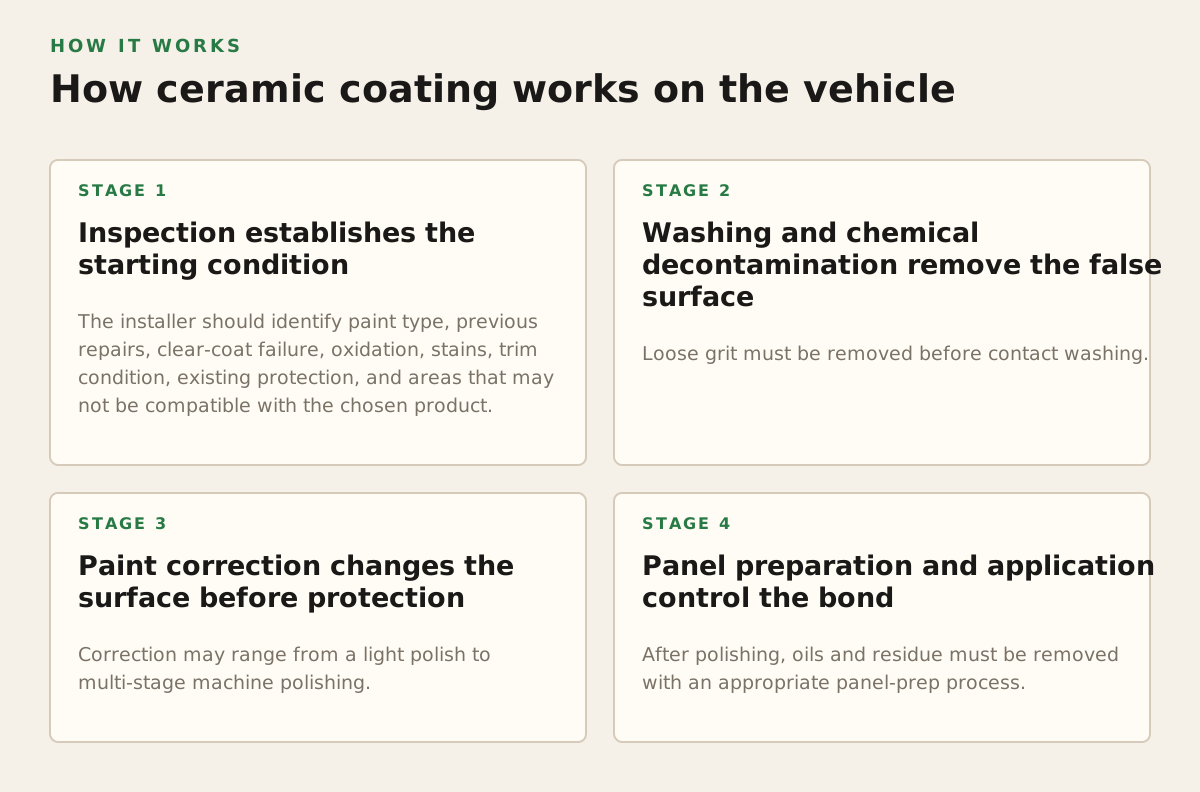
A successful installation is a chain of controlled steps. Skipping one step can create a failure that gets blamed on the chemistry even though the problem began with contamination, incomplete correction, excessive product, or premature exposure to water.
1. Inspection establishes the starting condition
The installer should identify paint type, previous repairs, clear-coat failure, oxidation, stains, trim condition, existing protection, and areas that may not be compatible with the chosen product. Repainted panels deserve special caution because cure behavior and solvent sensitivity can differ from factory paint.
Inspection also sets expectations. A coating can preserve a corrected finish, but it does not fill deep scratches back to factory condition. If a fingernail catches in a defect, the mark may extend through the clear coat. If the paint is failing, polishing may expose a larger problem rather than create a durable surface for coating.
2. Washing and chemical decontamination remove the false surface
Loose grit must be removed before contact washing. Then the vehicle may need iron fallout remover, tar remover, and mechanical clay or an equivalent decontamination process. Each step has a cost: chemicals can stain sensitive trim, aggressive clay can create marring, and solvent use must be controlled.
On commercial vehicles, buses, RVs, and boats, the installer also has to account for decals, graphics, seams, caulking, rubber, plastics, and previously repaired areas. Large vehicles make it tempting to rush. That is precisely where residue left along edges, around emblems, or in panel gaps can interfere with an even application.
3. Paint correction changes the surface before protection
Correction may range from a light polish to multi-stage machine polishing. The appropriate level is a trade-off between appearance, time, and remaining clear-coat thickness. The objective is not to chase every defect at any cost. A sensible installer prioritizes defects visible in normal lighting and avoids unnecessary removal of sound clear coat.
Illustrative example—not a universal benchmark: a lightly swirled three-year-old SUV might receive a refinement polish before coating, while a neglected black truck with deeper wash marks may need a separate correction proposal and a discussion about which defects will remain. A dealership reconditioning program may choose a repeatable one-step process rather than a show-car finish so vehicles can return to inventory consistently.
4. Panel preparation and application control the bond
After polishing, oils and residue must be removed with an appropriate panel-prep process. The coating is then applied in measured sections, spread evenly, and leveled within the product’s working window. Temperature, humidity, panel temperature, ventilation, lighting, and the installer’s timing all influence the result.
Too little product may produce incomplete coverage. Too much may leave high spots, streaks, or uneven texture. If the installer misses a high spot, the defect can cure into a visible patch. Correcting it may require localized polishing and reapplication. That is why controlled application and inspection lighting are as important as the bottle’s advertised durability.
Manufacturers publish different requirements, so an installer should follow the selected system’s technical instructions rather than combine guesses from unrelated products. For example, Gtechniq provides product-specific application information for its automotive coating range on its official ceramic coating product pages. The practical lesson is simple: product chemistry is not interchangeable, and a cure schedule should be documented for the product actually used.
5. Curing is a vulnerable period
A newly coated vehicle needs protection from water, dust, accidental contact, and contamination while the film stabilizes. The exact time depends on the system and conditions. The owner should receive written instructions covering when the vehicle may be driven, washed, exposed to rain, or placed under a cover.
Do not translate “cured” into “immune.” A cured coating can still be scratched, stained, abraded, or damaged by harsh chemicals. It can also become masked by mineral deposits and road film. Maintenance preserves the surface behavior; it does not merely preserve the shine.
- Day of installation: keep the vehicle protected according to the installer’s written cure instructions.
- First maintenance wash: use the timing and method recommended for that coating system.
- Routine washing: remove loose grit first, use clean wash media, and dry without grinding dirt across the paint.
- Contamination events: remove bird droppings, bug residue, and sap as soon as practical rather than waiting for the next scheduled wash.
- Inspection: if water behavior changes or deposits remain, clean and assess the surface before assuming the coating has failed.
Where ceramic coating breaks down
The most expensive mistake is buying a coating to solve a problem it was never designed to solve. Clear expectations protect both the vehicle and the owner’s budget.
It does not stop rock chips
A thin cured coating cannot absorb the same impact as a purpose-built urethane film. Highway trucks, gravel roads, construction routes, and track use can put sharp debris into the bumper, hood, fenders, mirrors, and rocker panels. If the primary concern is impact damage, consider paint protection film for high-risk zones. A modern film product is specifically engineered for that use; 3M describes its automotive paint protection film as a layer intended to help protect painted surfaces from hazards such as stone chips and road debris on its official paint protection film information page.
That does not mean every vehicle needs full-body film. A sensible plan can place film on the front bumper, partial hood, mirror caps, door cups, rocker panels, or luggage-loading areas while using coating elsewhere. The right division depends on mileage, road conditions, vehicle shape, and how long the owner intends to keep the vehicle.
It does not prevent wash marring
Coatings can be hard, but hardness is not the same as scratch-proof performance. Dirt trapped in a sponge or towel can act like abrasive media. Automatic tunnel brushes, contaminated self-service tools, dry dusting, and snow brushes can mark the surface. A coating may make careful washing easier, but it cannot make careless washing safe.
A coated vehicle should generally be maintained with:
- A shaded, reasonably cool washing location when practical.
- A pre-rinse or foam stage to loosen loose grit.
- Separate tools for wheels and painted panels.
- Clean, soft wash media changed or rinsed frequently.
- Lubrication and light pressure rather than aggressive scrubbing.
- Drying towels or air drying methods that do not drag visible dirt over the paint.
It does not eliminate water spots
Mineral-rich water can dry into deposits on coated or uncoated paint. In some cases, the coating’s hydrophobic behavior makes the deposit more apparent because water gathers into distinct drops. The answer is not automatically a stronger chemical. The owner should identify whether the issue is ordinary road film, mineral scale, or actual etching, then use a compatible maintenance product or professional decontamination process.
It does not repair failing paint
Peeling clear coat, rust bubbles, exposed primer, cracked paint, and poorly bonded repairs need body and paint work. Applying a coating over unstable material does not make the underlying surface stable. On a used vehicle, money may be better directed toward correcting a damaged panel, treating corrosion, or applying film to an intact area rather than coating every panel indiscriminately.
Even the best coating can lose its useful behavior through chemical abuse. Strong degreasers, solvent exposure, abrasive compounds, neglected deposits, and repeated high-friction cleaning can shorten service life. For a fleet, this means the wash contractor’s process is part of the protection decision—not an afterthought.
How practitioners match the treatment to the vehicle
The best installation is not necessarily the most expensive or most extensive package. It is the one that matches the vehicle’s exposure, paint condition, maintenance habits, and appearance goals.
Personal cars, SUVs, and trucks
For a Metro Detroit daily driver, start with the paint’s current condition and parking pattern. A new or well-kept vehicle may need light preparation. A used black SUV may need correction before any coating makes sense. A work truck may benefit from coating on painted sides and a film package on the front-facing impact areas.
Ask for a written scope that separates:
- Wash and chemical decontamination.
- Paint correction level and the defects it is intended to improve.
- Coating product and the surfaces included.
- Trim, glass, wheels, and interior exclusions.
- Cure instructions and maintenance requirements.
- What happens if a high spot or missed section is discovered.
Do not choose solely from a durability number. The useful questions are whether the installer can prepare the paint properly, explain limitations, document the maintenance plan, and inspect the finished vehicle under suitable lighting.
Motorcycles, dirt bikes, ATVs, and powersports vehicles
Powersports equipment has tight contours, textured plastics, exposed fasteners, decals, matte panels, and areas that are difficult to towel-dry. A coating selected for glossy automotive paint may not be suitable for every substrate. The installer should identify painted metal, gel coat, molded plastic, satin finishes, and graphics before promising a uniform result.
For a dirt bike or ATV, mud removal can involve more pressure and more frequent washing than a commuter car. Protection should therefore be paired with a realistic cleaning method. Avoid treating coating as permission to direct extreme pressure at bearings, seals, electrical connectors, or decals.
Boats, jet skis, and RVs
Marine and recreational vehicles face additional exposure from mineral-rich water, fuel residue, algae, dock contact, oxidation, and long periods outdoors. Gel coat and fiberglass are not automatically equivalent to automotive clear coat. Large RVs also contain vinyl graphics, roof materials, rubber seals, ladders, vents, and textured plastics.
A professional inspection should identify which surfaces are eligible, which need oxidation removal first, and which require a separate product. A boat owner who wants easier cleanup on the hull may still need a distinct plan for non-skid decking and underwater components. An RV owner may prioritize the front cap and graphics while treating the roof through a separate maintenance program.
Dealerships and fleet accounts
For dealerships, consistency and turnaround may matter more than a maximum-detail finish on every unit. A written process can define inspection, wash, correction level, application areas, cure control, and delivery instructions. Fleet managers should also consider vehicle downtime, wash chemistry, driver habits, and whether the units return to the same facility for maintenance.
An illustrative starting policy—not a universal benchmark—could divide vehicles into three groups: new units needing preparation only, used units needing one-step correction, and damaged or oxidized units requiring approval before protection. That classification helps prevent a coating technician from treating every vehicle as if it had the same paint condition.
| Vehicle or use case | Primary concern | Practical protection emphasis |
|---|---|---|
| Metro Detroit commuter car | Salt, road film, outdoor parking | Preparation, coating, prompt winter washing |
| High-mileage pickup | Rock chips and abrasive road debris | Coating plus film on high-impact painted areas |
| Weekend sports car | Gloss, contamination, careful upkeep | Correction followed by coating; consider film for the nose |
| Motorcycle or ATV | Complex surfaces and frequent dirt | Substrate-specific product and controlled cleaning |
| RV, bus, or commercial vehicle | Large panels, graphics, downtime | Documented process matched to paint, gel coat, and graphics |
When impact protection is the leading concern, review ppf separately from a coating decision; ppf is intended to manage a different kind of road damage. When the paint is suitable and the owner wants easier maintenance plus a sharper finish, coating may be an appropriate part of the exterior care plan.
Rite-Way Auto Reconditioning serves personal vehicles, dealerships, fleets, boats, RVs, motorcycles, powersports equipment, buses, and commercial vehicles throughout Greater Metro Detroit. For a vehicle-specific recommendation that weighs paint condition, exposure, correction, coating, film, tinting, rustproofing, and undercoating together, contact Rite-Way Auto Reconditioning rather than selecting protection from a product label alone.