A car paint protection coating is a professionally applied protective layer that bonds to a vehicle’s prepared paint or another compatible surface to reduce contamination adhesion, chemical staining, ultraviolet exposure, and everyday washing wear. It is not the same as a wax, and it is not an invisible substitute for impact protection. For a Greater Metro Detroit vehicle owner, the useful question is not simply “Which coating is best?” It is “Which protection matches this vehicle’s exposure, condition, storage, and maintenance habits?”
What a Car Paint Protection Coating Actually Is
The phrase “paint protection coating” covers several different technologies. Most conversations involve a ceramic or glass-like coating, but some shops also use polymer coatings or specialized systems such as Icon Rocklear. They differ in chemistry, application process, hardness, appearance, maintenance requirements, and the type of damage they can realistically resist.
A coating is generally a liquid product that is spread over a clean, decontaminated surface. Its carrier flashes off, leaving a thin bonded layer. The finished surface may feel slick and show strong water behavior, but those visible effects are only part of the function. The practical value comes from how the cured layer interacts with water, oils, road film, bird droppings, tree sap, detergents, and the underlying clear coat.
Coating, wax, sealant, and film are different tools
- Wax sits on the surface and can improve gloss and water behavior, but it is generally treated as a shorter-term maintenance product.
- Synthetic sealant uses engineered polymers for more consistent durability than many traditional waxes, but it still remains a surface treatment rather than a physical shield against rock impact.
- Ceramic coating chemically bonds or strongly anchors to prepared paint and creates a durable, low-surface-energy layer. The exact chemistry and durability depend on the product and installation.
- Paint protection film is a transparent physical film with measurable thickness. It is selected when impact resistance against stones, gravel, and road debris matters most.
- Undercoating and rustproofing protect different vehicle areas and should not be confused with a finish coating for painted panels.
That distinction matters on a new Ford F-150, a restored Corvette, a daily-driven Subaru, and a dealership inventory vehicle alike. A ceramic layer can make washing easier and help preserve gloss, while it will not stop a sharp stone from chipping a hood. A film may be the better choice for a front bumper, rocker panel, or motorcycle fork guard, while a coating may make sense on the rest of the vehicle.
Manufacturers describe modern paint protection films as multilayer products designed for automotive painted surfaces, not merely thick plastic sheets. For example, 3M’s official paint protection film information discusses film construction and automotive applications. That supports the basic division of labor: film addresses physical impact, while a coating primarily addresses surface contamination, cleaning, and environmental exposure.
What “bonded” does and does not mean
Bonding does not mean the coating becomes part of the entire paint system or repairs defects underneath it. If a panel has wash marring, oxidation, sanding marks, silicone contamination, or leftover polishing oils, the coating can preserve or emphasize that condition. Preparation is therefore part of the protection system, not an optional cosmetic prelude.
A coating also cannot correct rust that has already reached the paint edge, stop a failing clear coat, or make a repainted panel chemically identical to an original factory panel. A responsible installer inspects the finish first and explains where correction, touch-up, repainting, or a different protective material is more appropriate.
Why Metro Detroit Vehicles Benefit From the Right Protection
Paint damage is cumulative. One drive rarely ruins a finish; repeated exposure combined with delayed washing, abrasive cleaning, and poor storage creates the visible decline. Southeastern Michigan adds several practical stressors: winter road treatments, freeze-thaw cycles, slush, construction dust, summer sun, insects, tree residue, and long periods when a vehicle cannot be washed conveniently.
Road salt is especially important because it can remain in seams, behind trim, around emblems, and on lower body panels. It does not have to visibly rust a painted panel to create a cleaning problem. Salt-laden grime attracts moisture and can make an already contaminated surface harder to clean safely. For that reason, exterior coating should be considered alongside wheel cleaning, underbody rinsing, and rustproofing rather than as a complete corrosion-control plan.
Ultraviolet exposure is another slow mechanism. The National Weather Service and NOAA explanation of the UV Index describes how ultraviolet intensity varies with conditions such as sun angle, altitude, clouds, and atmospheric factors. A coating cannot eliminate UV exposure, but a properly maintained protective layer can be one part of a broader plan that includes shade, garage storage, and regular decontamination.
The vehicle’s use determines the risk
Consider the difference between these owners:
- A leased crossover parked outdoors near Detroit may prioritize easier washing and better gloss retention before lease return.
- A black performance car driven on summer weekends may prioritize visual clarity and careful correction before coating.
- A work truck traveling gravel-strewn roads may need impact film on vulnerable panels before any broad coating application.
- A motorcycle or ATV may need protection on painted plastics, fuel tanks, and glossy trim, but its exposed metal, controls, and textured components require separate product decisions.
- A boat or jet ski may need a coating compatible with gelcoat or marine finishes, not an assumption that an automotive product belongs on every surface.
- A dealership may value consistent presentation and efficient maintenance across inventory, while a fleet manager may value repeatable washing and reduced downtime more than maximum show-car gloss.
Those are different jobs-to-be-done. “More durable” is incomplete unless the owner identifies what the surface is being asked to withstand. A garage-kept coupe and a salt-season commuter should not receive the same recommendation automatically.
What coatings can realistically prevent
A sound coating may reduce how strongly contaminants adhere and can give the owner more time to remove bird droppings, bug residue, tree sap, and road film before they etch or stain the finish. It can also improve water sheeting or beading, which helps reveal whether a panel is dirty and can shorten the time needed for a careful wash.
It does not make paint invulnerable. A useful protection decision separates chemical exposure, abrasive washing, and impact damage:
| Threat | Coating’s likely role | Better companion or alternative |
|---|---|---|
| Bird droppings and insects | May reduce adhesion and slow staining when contamination is removed promptly | Safe spot cleaning and timely washing |
| Light road film | Can make routine cleaning easier | Pre-rinse, proper wash media, and drying technique |
| Swirl marks from dirty towels | Does not make careless washing safe | Paint-safe wash process and clean microfiber |
| Rock chips | Little meaningful protection against direct impact | Paint protection film or touch-up repair |
| Rust at stone chips | Does not reverse exposed metal corrosion | Prompt chip repair and corrosion treatment |
| Brake dust on wheels | Only if the product is approved for that wheel finish | Wheel-specific coating and maintenance plan |
How the Coating Works From Preparation Through Cure
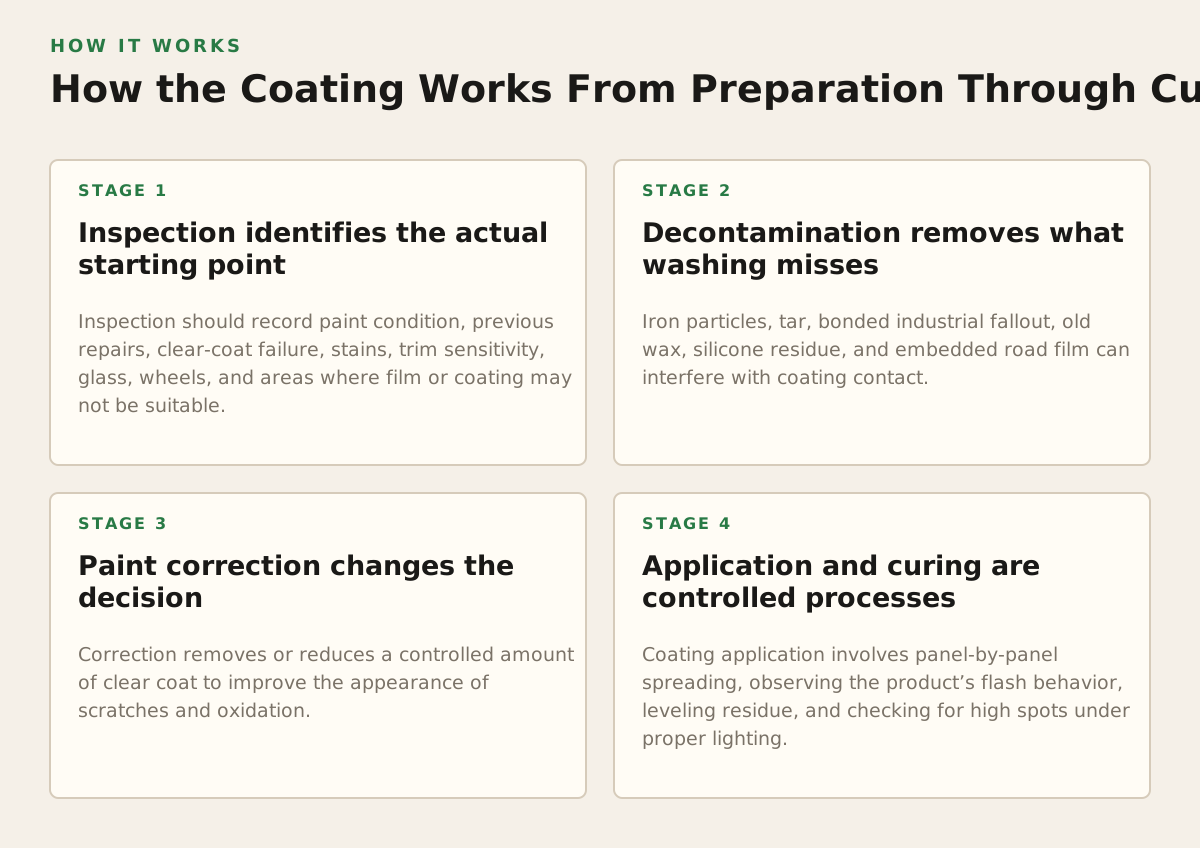
Most failures blamed on a coating begin before the bottle is opened. The installer must create a clean, compatible, uniformly receptive surface. That usually means washing, chemical decontamination, mechanical decontamination when appropriate, drying, inspection, and some degree of polishing.
Step 1: Inspection identifies the actual starting point
Inspection should record paint condition, previous repairs, clear-coat failure, stains, trim sensitivity, glass, wheels, and areas where film or coating may not be suitable. A dealership vehicle may need a fast but controlled presentation service. A collector car may justify a slower correction process. A commercial van may need a protection plan that tolerates frequent washing and occasional decals.
Paint thickness is not automatically known from the vehicle’s age or brand. Repainted panels can have different film builds and different polishing limits. A technician should avoid promising the same correction level on every panel when the surface history is unknown.
Step 2: Decontamination removes what washing misses
Iron particles, tar, bonded industrial fallout, old wax, silicone residue, and embedded road film can interfere with coating contact. Chemical decontamination must be used according to the product’s instructions and rinsed thoroughly. Aggressive clay use can create marring, especially on soft or dark paint, so the least aggressive effective approach is preferable.
The panel is then dried and inspected under suitable lighting. If water remains in mirrors, trim, emblems, grilles, or body seams, it can reappear during application and create unevenness. This is an ordinary practical failure, but it is one reason rushed installations produce inconsistent results.
Step 3: Paint correction changes the decision
Correction removes or reduces a controlled amount of clear coat to improve the appearance of scratches and oxidation. It does not remove every defect safely. Deep scratches that catch a fingernail, chips, edge damage, and defects through the clear coat may require touch-up or bodywork rather than more polishing.
For a new vehicle, “new” does not guarantee defect-free paint. Transport washing, dealership lot care, adhesive removal, and previous detailing can leave marring. For a used black SUV, a coating applied without correcting the most visible defects may preserve a disappointing reflection for years.
Use this illustrative decision sequence rather than treating it as a universal standard:
- A light-colored daily driver with minor haze may receive decontamination and a light enhancement polish.
- A black sports car with obvious swirls may need a more involved correction before protection, with the owner choosing between maximum visual improvement and preserving paint.
- A truck with deep chips on the hood may receive chip repair or front-end film before a coating is considered.
- A fleet van with sound paint but heavy weekly use may receive modest preparation and a repeatable maintenance coating rather than an extensive show-car correction.
- A motorcycle with painted tank damage may need spot correction while textured plastics and rubber parts are excluded or treated with compatible products.
Step 4: Application and curing are controlled processes
Coating application involves panel-by-panel spreading, observing the product’s flash behavior, leveling residue, and checking for high spots under proper lighting. Temperature, humidity, airflow, panel temperature, and product instructions affect working time. A product that looks clear in one lighting condition can reveal a streak after it cures.
The vehicle also needs an appropriate cure period. Exact instructions differ by product, facility, weather, and whether the vehicle is kept indoors. The installer should provide specific guidance on rain, washing, dust, and first maintenance rather than giving a vague promise that the car is immediately ready for anything.
Product makers publish their own technical and care instructions. For example, Gtechniq’s official ceramic coating information separates coating products and application considerations rather than treating every liquid protectant as interchangeable. The actionable lesson is simple: follow the chosen system’s instructions, including surface compatibility and cure requirements, instead of borrowing directions from a different bottle.
Where Paint Protection Coatings Break Down
A coating is not a force field. Its boundaries should be explained before purchase because unrealistic expectations create more dissatisfaction than the product’s limitations themselves.
Impact is a different physical problem
Rock chips happen when a hard object transfers energy into a small area. A thin cured coating can reduce contamination and may offer some limited surface resistance, but it does not provide the sacrificial thickness of a transparent film. If the owner’s primary concern is highway gravel on a hood, bumper, mirror, or rocker, a film-first plan deserves consideration.
Paint protection film also has limits. It can be cut, lifted by poor installation, stained by contamination, or damaged at exposed edges. It requires compatible installation surfaces and careful removal if replaced. The correct recommendation may be partial film on impact zones and a coating on the remaining painted surfaces, not an all-or-nothing choice.
For owners comparing a broad coating package with ppf, ask three questions: Where does the vehicle receive impacts? How much of the appearance must remain original? Will the owner maintain exposed film edges and the surrounding paint? The answer may differ between a Corvette, a lifted truck, and a delivery van.
Hardness claims need context
Marketing often uses hardness language as if a laboratory pencil test predicts road performance. It does not. A hardness rating under a particular test method is not the same as resistance to a sharp stone, a metal key, automatic brush contact, or a dirty drying towel. Even a highly resistant coating can be scratched by abrasive contamination dragged across the surface.
For any coating, avoid promises that imply:
- complete scratch prevention;
- permanent protection without maintenance;
- protection against dents, chips, or collision damage;
- permission to use automatic brushes or harsh chemicals;
- safe application over failing clear coat or active rust;
- identical durability on paint, plastic, chrome, glass, gelcoat, and powder coat.
Maintenance still controls the outcome
Hydrophobic behavior can decline when a surface becomes coated with traffic film, minerals, oily residue, or iron contamination. That does not always mean the underlying coating has disappeared. Sometimes the surface needs a proper wash and decontamination; sometimes it has been chemically damaged or mechanically worn.
Maintenance should match the vehicle:
- Rinse salt and gritty winter film before touching the paint.
- Use a clean, lubricated wash process rather than wiping a dry dusty panel.
- Remove bird droppings, insects, and tree sap promptly with a safe method.
- Use products approved for the coating and avoid strong solvents unless the installer directs otherwise.
- Dry with clean equipment and do not let mineral-heavy water evaporate repeatedly on the finish.
- Schedule inspection when water behavior changes across only a few panels or when staining remains after washing.
These habits are particularly important for fleet operators and dealerships. A coating does not compensate for a shared wash bay filled with dirty brushes, reused towels, or uncontrolled chemical dilution. A written process can matter more than a higher-priced product if several employees or vendors touch the vehicles.
How Practitioners Apply the Choice to Real Vehicles
The best recommendation begins with a surface map and an exposure map. A technician should identify what is painted, what is plastic, what is textured, what is wrapped, what is glass, and what receives the most abuse. Then the owner’s storage, mileage, washing access, and time horizon determine how much preparation and protection make sense.
Personal cars, SUVs, and trucks
For a Metro Detroit commuter, a professional ceramic coating can be a sensible way to improve cleanability and preserve a well-prepared finish, especially when the vehicle is stored indoors or washed consistently. It is less sensible if the owner expects it to prevent highway chips on an unprotected front end.
A practical truck plan may divide the vehicle into zones:
- front bumper, hood leading edge, mirrors, and rocker areas: consider impact film where exposure justifies it;
- hood, roof, doors, and bed sides: consider a coating after suitable correction and decontamination;
- wheels: use a wheel-compatible product if brake dust and winter grime are major concerns;
- plastic trim: verify compatibility before application because trim products and paint coatings are not automatically interchangeable;
- underside and frame: address salt exposure through washing, inspection, and a separate rustproofing or undercoating strategy.
For a leased vehicle, the owner may prioritize clean presentation and avoiding preventable stains rather than pursuing a multi-stage correction. For a restored or high-value sports car, the owner may accept more preparation time to obtain a clearer finish, while still using film on the highest-impact areas.
Motorcycles, ATVs, boats, and RVs
Powersports vehicles introduce more contact points and more varied materials. Fuel tanks can be exposed to spills, motorcycles collect chain lubricant and road grit, and ATVs encounter mud, brush, and abrasive trail debris. A coating may help with cleanup on compatible glossy panels, but it does not make painted plastics, decals, rubber, seats, grips, or matte finishes universally safe for the same product.
Boats and jet skis require attention to gelcoat, painted metal, graphics, nonskid surfaces, and frequent water exposure. An automotive coating should not be assumed suitable for marine surfaces without manufacturer approval. RVs and buses combine large painted areas with roof materials, seals, decals, ladders, compartments, and difficult access. The labor and maintenance plan can therefore matter as much as the chemistry.
Dealerships and fleet accounts
For a dealership, the relevant metric is not a dramatic promise on one display vehicle. It is whether the process can be repeated without introducing new marring, whether staff know which chemicals are allowed, and whether the vehicle remains presentable through transport, lot storage, test drives, and delivery preparation.
Fleet managers should document:
- vehicle types and paint or body materials;
- primary routes, including gravel, construction zones, and winter exposure;
- washing frequency and who performs it;
- areas that suffer repeated chips, scuffs, or chemical staining;
- downtime available for preparation and curing;
- the inspection method for deciding when a surface needs correction or reapplication.
A fleet may benefit from different protection by vehicle class. Highway tractors, municipal buses, service vans, and executive vehicles do not experience the same contamination or impact profile. A standardized coating on every surface can be less practical than a zone-based program combining correction, film, coating, rustproofing, and documented maintenance.
Where rock impact is the dominant problem, a professionally installed ppf treatment may be more rational on selected panels than applying a coating alone. Where contamination, appearance, and wash efficiency dominate, coating may be the better primary tool. The decision should be based on the damage mechanism, not the product category that sounds most advanced.
A Specific Recommendation Before You Schedule Protection
Start with a written inspection and a conversation about exposure, not a promise about gloss. Tell the installer where the vehicle is parked, how it is washed, how many miles it travels, whether it sees salt or gravel, and which defects already bother you. Ask what preparation is included, which surfaces are excluded, how the cure period works, what maintenance products are recommended, and what the coating will not protect against.
For a well-maintained personal car or SUV with sound paint, choose a professional coating when easier cleaning and long-term finish preservation are the main goals. Add impact film to high-risk areas when chips are the main concern. For a truck, motorcycle, boat, RV, bus, commercial vehicle, dealership inventory, or fleet, use a surface-by-surface plan rather than assuming one product should cover everything.
Rite-Way Auto Reconditioning serves Greater Metro Detroit with detailing, paint correction, ceramic coatings, Icon Rocklear paint protection, window tinting, rustproofing, and undercoating for personal vehicles, dealerships, fleets, boats, RVs, motorcycles, powersports vehicles, buses, and commercial vehicles; Rite-Way Auto Reconditioning can help you match the protection to the actual vehicle and exposure.