Paint protection ceramic coating is a liquid-applied protective layer that chemically bonds to a properly prepared vehicle surface and cures into a thin, hard, low-surface-energy film. It is not a replacement for clear coat, paint protection film, or careful washing. Its practical job is to make painted surfaces easier to clean, more resistant to chemical contamination and light environmental wear, and more consistent in appearance.
That distinction matters in Greater Metro Detroit. A daily-driven SUV deals with road salt, brine, slush, industrial fallout, bird droppings, hot summers, automatic-wash brushes, and abrasive winter washing. A weekend sports car may face fewer miles but receive closer scrutiny. A motorcycle, boat, RV, fleet van, or dealership inventory vehicle has a different exposure pattern and a different return on protection. The right recommendation depends on the surface, the use schedule, the storage conditions, and what the owner expects the coating to prevent.
What a Ceramic Coating Actually Is
Automotive ceramic coatings are usually formulated from reactive silane, siloxane, or silica-based chemistry carried in a solvent or water-based carrier. During application and cure, the carrier evaporates while reactive ingredients form a network that bonds to a clean, prepared surface. The finished layer is extremely thin compared with a film product. It does not add meaningful impact absorption, rebuild missing clear coat, or make a vehicle scratch-proof.
Coating versus wax, sealant, and film
A wax generally sits on the surface as a sacrificial layer and is periodically renewed. A synthetic sealant also creates a water-repellent barrier, often with easier application and shorter preparation requirements than a professional coating. A ceramic coating is intended to create a more durable bonded layer, but durability still depends on product chemistry, application conditions, surface preparation, maintenance, and exposure.
Paint protection film uses a substantially different mechanism. It is a physical urethane film that can absorb and distribute some impact from road debris. That makes it better suited to leading edges, rocker panels, door cups, loading areas, and other high-impact zones. The 3M overview of paint protection film describes PPF as a film applied to painted surfaces for protection from hazards such as stone chips and road debris. A coating can be installed over or around selected film areas, but it does not perform the same job as PPF.
- Wax or sealant: a maintenance layer for gloss, water behavior, and short-term contamination resistance.
- Ceramic coating: a bonded surface treatment that improves cleanability and chemical resistance when properly maintained.
- Paint protection film: a physical barrier for impact-prone areas; see Rite-Way’s ppf for the separate protection approach.
- Paint correction: abrasive refinement that reduces suitable defects before protection is installed.
- Clear coat: the original transparent paint layer that still provides much of the vehicle’s underlying protection.
What “hard” does and does not mean
Hardness is often used in coating marketing, but it is not a universal measure of scratch prevention. A hard coating may resist some marring and chemical attack, yet a gritty wash mitt, dry towel, automatic brush, or dragged piece of equipment can still damage the coating and the paint beneath it. A coating also cannot correct a chip, dent, deep scratch, failing clear coat, or rust bubble.
The useful definition is therefore functional rather than promotional: a ceramic coating is a bonded, low-energy sacrificial surface that changes how water, dirt, oils, and contaminants interact with the paint. It is valuable when the owner wants easier washing and more stable gloss, not when the owner expects an invisible force field.
Why the Protection Matters in Metro Detroit
Paint damage is cumulative. One event may be harmless, but repeated wetting, drying, contamination, and abrasion can change the surface. Winter salt residue attracts moisture and can remain in seams, emblems, trim edges, wheel wells, and lower body panels. Spring brings pollen and road film. Summer adds intense sun, insects, and bird deposits. Fall brings leaves, sap, and damp storage conditions.
A coating helps most by reducing the effort required to remove contamination before it bonds or dries. Water behavior is part of that benefit, but beading alone is not proof that the coating is healthy. A surface can bead because of a temporary topper, leftover detergent, or a different product on the panel. The more meaningful questions are whether contamination releases with appropriate washing, whether the surface remains uniform, and whether the coating has been maintained according to its instructions.
Environmental exposure is not the same as impact protection
Road salt illustrates the boundary clearly. A coating may make salt film easier to rinse from painted panels, but it cannot stop saltwater from entering an existing chip, seam, fastener pocket, or underside cavity. It cannot repair corrosion that has already begun. For rust prevention, owners need a separate inspection and protection strategy for underbody areas, cavities, seams, and vulnerable hardware.
Washing practices also determine whether protection pays off. The United States Environmental Protection Agency explains that polluted wash water can carry detergents, oils, grease, and other contaminants into storm drains or waterways, while commercial car washes commonly direct wastewater to treatment systems. Its car-wash stormwater guidance supports a practical point for owners and fleet managers: choose a washing process that controls runoff as well as surface abrasion.
Different vehicles, different reasons to coat
- Daily cars and SUVs: easier removal of winter film and road grime can reduce the temptation to postpone washing until contamination is baked on.
- Trucks: a coating can simplify cleanup of painted beds, cab sides, tailgates, and fuel-door areas, but it will not stop gravel impacts on the front end.
- Sports cars: the value may be appearance consistency and reduced washing friction, especially after paint correction.
- Motorcycles, dirt bikes, and ATVs: coated painted plastics and metal panels may clean more readily, but engines, exhausts, matte finishes, rubber, and textured plastics require product-specific decisions.
- Boats and jet skis: marine exposure, spray, dock contact, oxidation, and incompatible cleaners make substrate identification essential; gelcoat is not automatically treated like automotive clear coat.
- RVs, buses, semis, and fleets: reduced cleaning labor may matter more than show-car gloss, but wash equipment, downtime, decals, repairs, and panel replacement must be considered.
- Dealership inventory: the process should fit the lot’s wash routine and reconditioning schedule rather than add a treatment that staff cannot maintain consistently.
For a fleet manager, the protection decision is operational. If a vehicle is washed frequently, stored outdoors, and exposed to dirty routes, a coating may reduce labor per wash. If a unit is repaired often, wrapped, heavily stickered, or replaced quickly, localized protection or a simpler sealant may be more sensible.
How a Ceramic Coating Works on the Surface
The result depends less on the dramatic moment of wiping the product on and more on what happens before, during, and after that wipe. A coating needs a surface that is clean, residue-free, sufficiently uniform, and compatible with the chemistry. Oils from polishing, silicone dressings, old waxes, mineral deposits, and detergent residue can interfere with bonding or cause uneven appearance.
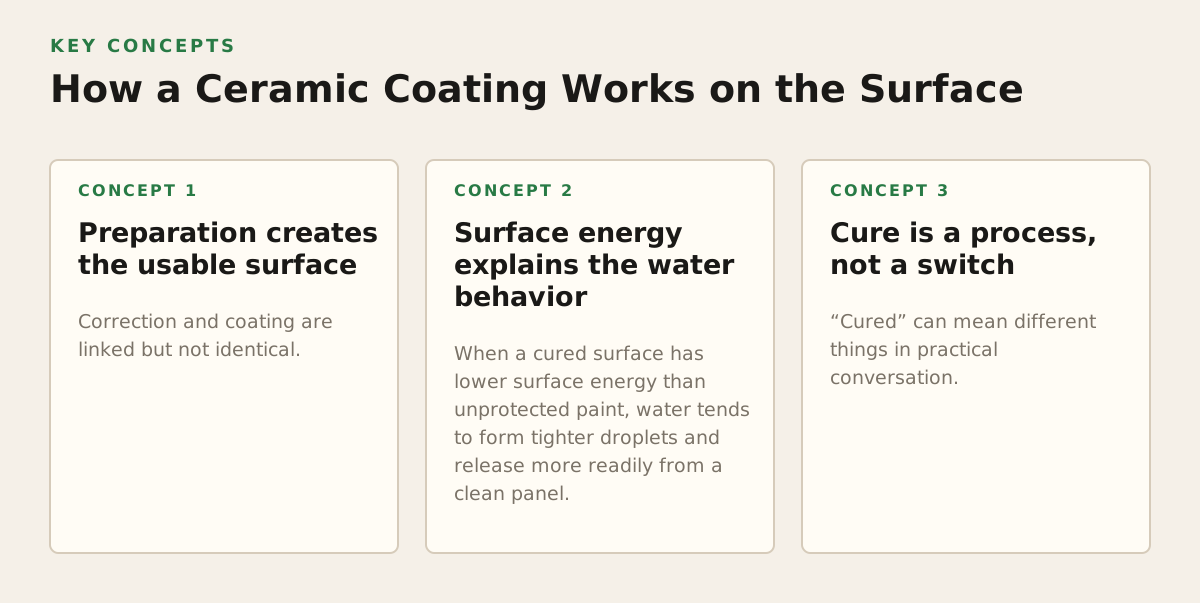
Preparation creates the usable surface
- Inspection: identify paint type, previous coatings, repainted panels, oxidation, scratches, chips, trim, decals, film, and areas that should not receive the product.
- Decontamination: remove loose soil, bonded fallout, tar, sap, and mineral deposits using methods appropriate to the substrate.
- Correction: refine swirls, haze, oxidation, and selected defects when the owner approves the loss of paint required to reduce them.
- Panel preparation: remove polishing oils and residues without spreading them into gaps, badges, sensors, or porous trim.
- Application: lay down a controlled amount in a manageable section, observe the product’s flash behavior, and level high spots before they cure.
- Cure management: keep the surface within the product’s specified environmental range and protect it from premature water, dust, and contact.
Correction and coating are linked but not identical. If a deep scratch remains after safe correction, coating over it does not make it disappear. If the paint is already thin or the panel has uncertain repair history, aggressive correction can create more risk than visual benefit. A sensible process may preserve some defects rather than chase perfect-looking paint.
Surface energy explains the water behavior
When a cured surface has lower surface energy than unprotected paint, water tends to form tighter droplets and release more readily from a clean panel. Oils and some contaminants also have less tendency to spread across the surface. This is why a coated vehicle may rinse more easily and show strong beading.
That behavior has limits. Mineral-rich water can dry into deposits. Dust can sit on the surface. A droplet left under sunlight can concentrate dissolved material as it evaporates. A coating is not self-cleaning in the literal sense; it still needs appropriate washing. Some “coating failure” reports are actually mineral spotting, detergent residue, traffic film, or a topper masking the underlying behavior.
Manufacturers vary in chemistry and care requirements. For example, Gtechniq’s official ceramic coating product information separates coating products and describes different intended uses and application considerations. That is why a generic internet rule about one cure time, one maintenance product, or one layer count should not override the selected product’s technical instructions.
Cure is a process, not a switch
“Cured” can mean different things in practical conversation. A coating may be safe to level after a short flash period, safer to handle later, and fully developed only after a longer cure under controlled conditions. Temperature, humidity, film thickness, air movement, surface temperature, and contamination all influence the result.
For an illustrative shop policy, an installer might divide a vehicle into manageable sections, verify lighting after each panel, keep the vehicle indoors during the initial cure window, and give the owner written wash instructions. Those are starting procedures, not universal timelines. The product’s technical sheet and the installer’s environmental controls should govern the actual process.
Where Ceramic Coating Breaks Down
The most expensive mistake is buying a coating for a problem it was never designed to solve. A coating improves the surface; it does not change the vehicle’s exposure, eliminate physical contact, or excuse poor maintenance.
Impact and abrasion remain physical problems
Stone chips, gravel, road debris, branches, loading ramps, shopping carts, brush bristles, and pressure-washer misuse can exceed what a thin coating can withstand. The front bumper of a highway-driven truck and the rear hatch of a frequently loaded SUV may need different strategies. Use PPF where impact is the concern, and consider a coating on exposed painted areas where easier cleaning is the priority.
Even a careful owner can create marring by washing a dirty panel with insufficient lubrication or by reusing a contaminated towel. Touchless washing reduces contact but may require stronger chemicals. Hand washing offers more control but creates more opportunities for abrasive contact. Neither method is automatically safe.
Chemicals and contamination can overwhelm the layer
Bird droppings, insect remains, tree sap, industrial fallout, brake dust, and hard-water deposits can become difficult to remove when allowed to dry repeatedly. Strong acids, caustic cleaners, solvents, petroleum products, and unapproved degreasers may degrade a coating or alter its appearance. The correct response is not to apply stronger chemicals immediately; identify the contamination and use the least aggressive compatible method.
Surface spotting deserves special attention. A coating can make water collect into distinct droplets, and those droplets can leave concentrated mineral rings after evaporation. If spotting persists, polishing may remove the coating in that area. The owner should first confirm whether the issue is loose residue, mineral scale, or actual coating damage.
Maintenance determines the practical life
- Rinse loose grit before making contact with the paint.
- Use clean wash media and separate tools for wheels, lower panels, and upper paint.
- Work from cleaner upper surfaces toward dirtier lower areas.
- Dry with clean, suitable towels or controlled air rather than letting mineral-rich water evaporate repeatedly.
- Remove bird deposits, insects, sap, and fuel spills promptly instead of scrubbing a dried spot aggressively.
- Follow the coating manufacturer’s maintenance-product and inspection instructions.
For a clearly labeled illustrative maintenance schedule, a personal vehicle might receive a gentle wash after a heavily salted trip, a more thorough inspection at seasonal changes, and professional evaluation when water behavior or contamination release changes. Those intervals are not a promised service life or a universal benchmark; they are decision points that help prevent small issues from becoming correction work.
Existing paint condition sets the ceiling
Clear-coat failure, peeling paint, solvent pop, uncontrolled oxidation, rust, and poorly repaired panels should be resolved before coating whenever practical. A transparent coating does not conceal these problems for long. It can make an uneven surface look glossier while leaving the underlying defect fully visible.
Repainted panels also deserve caution. Fresh refinishing may have different hardness, solvent behavior, texture, and cure requirements from factory paint. A professional should identify those panels and follow the refinishing facility’s guidance before applying protection. The same caution applies to matte paint, satin finishes, vinyl wraps, powder coat, gelcoat, anodized metal, plastics, and rubber: compatibility must be confirmed rather than assumed.
How Practitioners Apply the Right Protection
A good recommendation starts with the owner’s use case, not a bottle or a claimed duration. The first appointment should answer what the vehicle needs protected from, what condition it is in, how it is washed, and how long the owner expects to keep it.
Build the protection plan around exposure
| Vehicle or use case | Primary risk | Reasonable starting approach | Important limitation |
|---|---|---|---|
| Metro Detroit daily driver | Salt film, traffic grime, frequent washing | Paint preparation followed by a coating and a repeatable wash plan | Does not prevent chips or rust in damaged areas |
| Highway truck or sports car | Stone impact on front-facing panels | PPF on selected impact zones, with coating on remaining paint if desired | Film edges and repairs need their own care |
| Motorcycle or powersports vehicle | Mixed materials, fuel exposure, mud, and equipment contact | Substrate-by-substrate inspection before selecting products | Exhausts, rubber, textured plastics, and hot surfaces may be excluded |
| Boat or jet ski | Saltwater, mineral deposits, oxidation, and dock contact | Marine-surface assessment and a compatible maintenance system | Automotive paint assumptions may not apply to gelcoat |
| Fleet, bus, RV, or commercial vehicle | Downtime, wash labor, decals, and varied operators | Standardized preparation and written wash procedures | Repair, graphics, and route conditions can reduce consistency |
Choose correction based on the owner’s tolerance
Paint correction is a trade-off between appearance and remaining material. Light polishing may improve gloss and reduce wash marks. More aggressive correction may reduce deeper defects but increases material removal and process time. A vehicle used every day in winter may be better served by strong decontamination and moderate refinement than by chasing every defect to showroom perfection.
Ask specific questions:
- Is the vehicle a daily driver, stored seasonally, or used for events?
- Will it be washed by hand, through a tunnel, by a fleet crew, or by a mobile operator?
- Are the front bumper and rocker panels already chipped?
- Does the owner want easier cleaning, maximum gloss, impact resistance, or all three?
- Are there repainted panels, wraps, decals, matte areas, or failing clear coat?
- Will the vehicle be sold, leased, or transferred before a long-term maintenance plan makes sense?
Set expectations in measurable language
A responsible recommendation says what the service is intended to improve and what it excludes. “Easier release of road film during proper washing” is testable in daily use. “Permanent protection from everything” is not. “Improved gloss after correction and coating” is reasonable when the paint can safely be refined. “No more scratches” is not.
For dealerships and fleet accounts, document the process with condition notes, panel exclusions, wash instructions, and repair cautions. A coating can be a useful part of reconditioning, but only when staff know which cleaner, brush, towel, and drying method are compatible. If a vehicle is frequently sent through an aggressive wash process, the process—not the marketing claim—will determine the result.
When another service is the better answer
Choose PPF when the principal concern is impact. Choose paint correction when the principal concern is visible wash marring or oxidation and the paint has enough safe working thickness. Choose rustproofing or undercoating when the concern is vulnerable underbody metal and cavities. Choose tinting when the job is glare, privacy, or solar management rather than exterior paint protection. These services can complement a coating, but none should be sold as a substitute for the others.
For Metro Detroit owners, the most durable plan is usually layered and selective: correct what is worth correcting, place physical film where impacts are predictable, coat compatible painted surfaces for easier maintenance, and keep salt and contamination from sitting unattended. Rite-Way Auto Reconditioning can help match ceramic coating, paint correction, PPF, detailing, rustproofing, and undercoating to a personal vehicle, powersports unit, boat, RV, dealership inventory, or fleet; start with Rite-Way Auto Reconditioning for a vehicle-specific recommendation rather than a one-size-fits-all promise.