Paint protection coating is a broad service term, not one single chemical or guaranteed level of protection. In this article, the primary subject is automotive ceramic coating: a liquid-applied product that is prepared, spread, and cured on suitable painted surfaces to make routine contamination easier to remove and help the finish resist some environmental exposure. The term can also be used loosely for other paint-protection products, including certain polymer sealants and specialized systems such as Icon Rocklear, so the product, preparation process, warranty terms, and maintenance instructions must be identified before you compare quotes.
That distinction matters in Greater Metro Detroit. A daily-driven crossover sees road salt, brine, brake dust, automatic-car-wash chemicals, summer dust, and repeated temperature changes. A weekend sports car may face fewer winter contaminants but receive more scrutiny under bright lighting. A motorcycle, boat, RV, bus, or commercial truck has different panel shapes, storage conditions, access problems, and downtime costs. The right question is not simply, “How glossy is the coating?” It is, “What exposure are we managing, what surface is being treated, and what maintenance can the owner actually follow?”
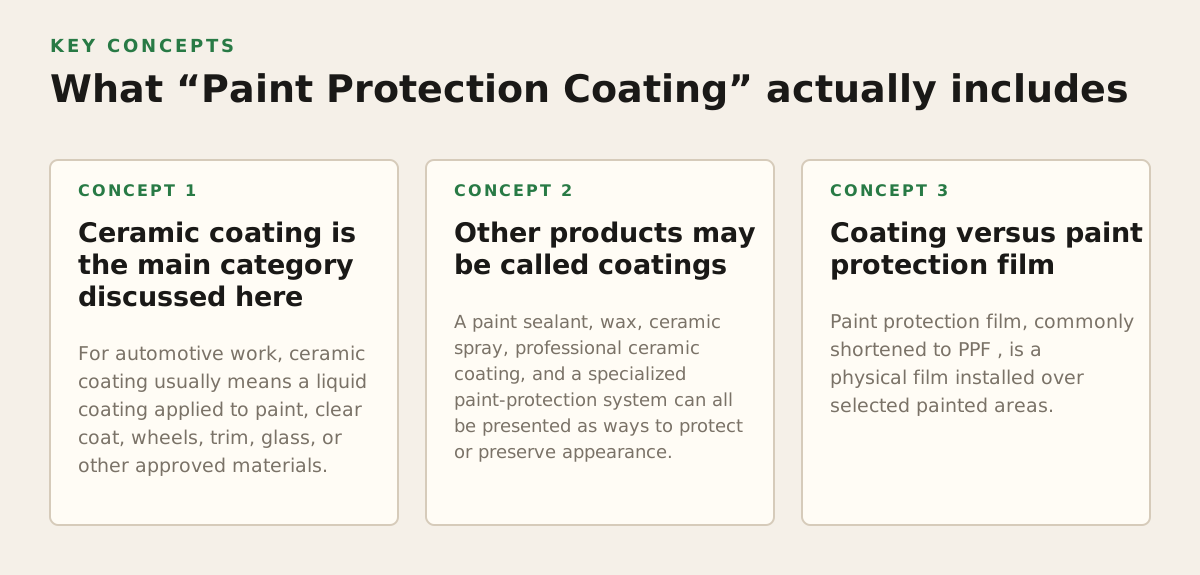
What “Paint Protection Coating” actually includes
A coating is best understood as a surface-treatment layer, not an invisible force field. The product bonds or adheres to a prepared surface and changes how water, dirt, oily residue, and other contaminants interact with that surface. Many ceramic coatings use silicon-based chemistry, but chemistry, solids content, application method, number of layers, cure schedule, and approved surfaces vary by product. A professional installer should be able to identify the system rather than describing every service as the same generic “ceramic.”
Ceramic coating is the main category discussed here
For automotive work, ceramic coating usually means a liquid coating applied to paint, clear coat, wheels, trim, glass, or other approved materials. Once cured, it can provide a more water-repellent surface and can make washing less laborious when the vehicle is maintained correctly. It does not rebuild missing clear coat, remove deep scratches, stop rock impacts, or make a neglected vehicle permanently self-cleaning.
Manufacturer descriptions can help explain intended use, but they are not a substitute for a vehicle inspection. For example, XPEL describes its FUSION PLUS line as a ceramic coating product for automotive surfaces and separates product instructions by application and surface type on its official site: XPEL FUSION PLUS product information. That kind of product-specific documentation is more useful than a generic promise that one coating works identically on paint, plastic, glass, leather, and marine surfaces.
Other products may be called coatings
A paint sealant, wax, ceramic spray, professional ceramic coating, and a specialized paint-protection system can all be presented as ways to protect or preserve appearance. They do not necessarily have the same preparation requirements, film thickness, curing behavior, durability claims, or repair options. “Coating” does not identify a performance class by itself.
Icon Rocklear should be discussed as its own system rather than casually treated as interchangeable with a ceramic coating. It may involve different product claims, preparation decisions, maintenance directions, and expectations about correcting or preserving a finish. A responsible consultation should explain which system is proposed and why it fits the vehicle. If a quote says only “paint protection coating,” ask for the product name, approved surfaces, preparation steps, cure instructions, and care requirements in writing.
Coating versus paint protection film
Paint protection film, commonly shortened to PPF, is a physical film installed over selected painted areas. It is not a liquid ceramic coating. The film may be chosen for high-impact zones such as the front bumper, hood edge, mirror caps, rocker panels, or luggage-loading areas. Official product information from 3M describes automotive paint protection film as a polyurethane film intended for vehicle paint protection: 3M automotive paint protection film information.
That difference creates a practical decision:
- Choose ceramic coating when easier cleaning, water behavior, gloss preservation, and broad surface coverage are the main goals.
- Choose PPF when preventing or reducing damage from road debris and abrasion in specific impact zones matters most.
- Combine them selectively when an owner wants physical film protection on vulnerable panels and coating benefits on exposed paint, wheels, or other approved surfaces.
- Consider a different coating system when the vehicle’s substrate, existing finish, commercial use, or maintenance schedule does not suit a conventional ceramic process.
Rite-Way’s coating service should therefore be evaluated alongside its ppf option when the vehicle faces frequent highway debris, winter driving, or demanding commercial use. The two services solve overlapping appearance concerns but different physical problems.
Why the coating matters in Metro Detroit conditions
The value of a coating is cumulative. It is not usually one dramatic event that proves the service; it is the possibility of making repeated cleaning and contamination management more controlled over the vehicle’s service life. In southeast Michigan, the finish may encounter salt and deicing residue during winter, pollen and insects in warmer months, construction dust, industrial fallout, bird droppings, and water spots after washing. Contamination becomes harder to remove when it is left to dry, bake, or bond repeatedly.
Salt and winter residue are maintenance problems
Road salt is not a scratch shield or a coating test that can be ignored until spring. Salt-laden grime can collect in seams, behind trim, around wheels, and along lower body panels. A coating may make some residue easier to rinse and wash away, but it does not eliminate the need to clean the vehicle. It also does not replace rustproofing, undercoating, or inspection of hidden metal surfaces.
For a commuter, the useful outcome may be a more manageable weekly or biweekly wash routine. For a fleet manager, the useful outcome may be a clearly documented cleaning process that reduces inconsistent care between vehicles. Those are different jobs to be done, and the coating should be sold or selected accordingly.
Hydrophobic behavior is useful but limited
Water beading is visually persuasive, but it is only one observable property. A panel can bead water and still have embedded contamination, scratches, poor gloss, or neglected trim. Conversely, a vehicle can be clean and protected even when beading changes because of mineral deposits, detergent residue, weather, or surface contamination. Beading is not the same as impact protection, and it is not a reliable stand-alone measure of coating health.
A coating can also change washing technique. If dirt releases more readily from a properly maintained surface, the owner may spend less time scrubbing aggressively. That matters because unnecessary pressure and dirty wash media can create marring. The coating does not make the paint immune to contact damage; it can support a gentler process when the owner supplies clean water, suitable wash media, and separate tools for wheels and paint.
Different vehicles have different payoffs
- Daily cars and SUVs: prioritize salt removal, easy washing, lower-panel inspection, and realistic winter access to a suitable wash location.
- Pickup trucks: consider bed edges, tailgate contact points, wheel faces, running boards, and frequent loading or towing exposure.
- Sports cars: prioritize paint correction, lighting evaluation, careful wash technique, and PPF on front-facing impact areas if highway use is significant.
- Motorcycles, dirt bikes, and ATVs: account for textured plastics, exposed hardware, mud, fuel contact, and whether the proposed product is approved for each substrate.
- Boats and jet skis: identify gelcoat, painted sections, vinyl, windows, and marine storage conditions instead of assuming an automotive coating is appropriate everywhere.
- RVs, buses, semis, and fleets: weigh vehicle size, wash access, downtime, driver or staff procedures, and whether the maintenance plan can be repeated consistently.
For a dealership, coating may be part of a reconditioning workflow rather than a retail add-on. The operational question becomes whether the finish is properly prepared, documented, and presented without overstating what the product does. For a private owner, the decision may be more personal: preserving the appearance of a new purchase, simplifying care for a dark-colored vehicle, or improving the presentation of a restored motorcycle.
How a professional ceramic-coating process works
A durable-looking result begins before the bottle is opened. The installer must evaluate the finish, remove contamination, correct defects when appropriate, and control the environment during application and curing. Preparation determines the starting surface; coating mainly preserves and changes the behavior of that prepared surface.
1. Inspection and scope
The process should start with an inspection under useful lighting. The installer looks for oxidation, sanding marks, water spots, swirl marks, previous coatings, resprayed panels, failing clear coat, plastic trim, decals, repaired areas, and contamination that ordinary washing will not remove. A new vehicle is not automatically defect-free. Transport dust, dealer washing, adhesive residue, and light marring can still be present.
For a used vehicle, the customer should receive an honest distinction between correction and coating. A coating can preserve a corrected finish, but it should not be used to disguise defects that remain visible under normal lighting. Deep scratches that have penetrated the clear coat, stone chips, peeling clear coat, and cracked paint may need refinishing or a different remedy.
2. Washing and decontamination
Washing removes loose soil; decontamination addresses material that remains bonded to the surface. Depending on the vehicle, that may include iron particles, tar, sap, old wax, adhesive residue, and mineral deposits. The method must be selected carefully for the substrate and finish. Abrasive or overly aggressive work can create new defects before the coating is applied.
Wheels and wheel wells deserve separate treatment because brake dust and road film can contaminate wash tools. Commercial vehicles and off-road equipment may require more attention to seams, hinges, racks, and textured surfaces. A realistic scope should state whether the service includes wheels, glass, trim, door jambs, interior surfaces, or only exterior painted panels.
3. Paint correction when justified
Paint correction may range from a light polishing step to more involved multi-stage work. It is not automatically beneficial to chase every defect. Removing too much clear coat to pursue a deep scratch can be a poor trade, especially on an older vehicle or a panel with limited finish thickness. A practitioner should explain what can be improved safely and what will remain.
For a new SUV with light dealer marring, an illustrative scope might be a careful wash, chemical and mechanical decontamination as needed, inspection, and a light polish before coating. That is an example of a starting process, not a universal prescription. A black sports car with heavier swirls, a repainted truck panel, and a fiberglass boat should not receive the same correction plan simply because all are described as “paint protection” jobs.
4. Application and curing
The coating is applied in controlled sections using the product’s stated coverage, flash, leveling, and removal instructions. Temperature, humidity, dust, lighting, and panel size can affect the installer’s working window. Application errors may leave high spots, streaks, uneven gloss, or residue that becomes harder to correct after curing.
The vehicle then needs the product’s specified cure conditions. The initial cure period is not necessarily the end of the maintenance obligation. The customer should receive instructions about water exposure, washing, detergents, bird droppings, and follow-up inspections. A coating is a maintenance system, not a one-day transaction.
5. Documentation and handoff
A useful handoff records the product or system used, treated surfaces, exclusions, preparation performed, care instructions, and any warranty or service terms. If a customer asks whether the coating was applied to glass, trim, wheels, or PPF, the answer should be specific. Product manufacturers commonly separate formulas and instructions by surface, which is why a single blanket statement about “full vehicle coverage” can be misleading.
Before approving work, ask these questions:
- What exact coating or protection system is being proposed?
- Which surfaces are included, and which are excluded?
- What correction and decontamination steps are included?
- What defects cannot be safely removed?
- How long must the vehicle remain dry or undisturbed after application?
- What wash products, tools, and intervals are recommended?
- What does the written warranty cover, and what maintenance voids or limits it?
Where Paint Protection Coating breaks down
Most disappointment comes from a mismatch between the product’s job and the owner’s expectation. Ceramic coating can support appearance preservation and cleaning, but it does not make a vehicle invulnerable. Rock chips, deep scratches, dents, and abrasion remain physical damage problems. A coating can be marked, contaminated, worn, or removed by aggressive correction just as paint can.
Impact damage requires a different strategy
Highway debris, gravel, motorcycle boot contact, repeated loading, and brush against a trail vehicle can exceed what a thin coating is intended to manage. If the priority is reducing damage from those impacts, PPF may be more appropriate on selected panels. Even PPF has edges, seams, installation limits, and maintenance requirements; it should not be represented as a universal answer either.
A practical example: an owner of a new performance car drives 80 miles daily on expressways and wants to preserve the front bumper. A ceramic coating across the vehicle may make washing and gloss maintenance easier, but it does not address the primary impact exposure as directly as PPF on the bumper, leading edges, and mirror caps. The coating and film can be complementary rather than competing purchases.
Contamination still needs prompt attention
Bird droppings, insects, tree sap, fuel, hard-water deposits, and road film should not be allowed to remain indefinitely. The coating may improve cleanability, but chemical exposure and heat can still stain or etch the surface. If a spill or dropping occurs, remove it using the approved method rather than scraping it dry.
Water spots deserve special caution. Minerals left behind after evaporation can sit above or within the surface contamination layer. Repeated polishing or strong chemicals may reduce the coating or alter the finish. The correct response depends on the product, the severity of the deposit, and whether the issue is contamination, coating residue, or paint damage.
Bad maintenance can erase the practical benefit
- Using one dirty towel for wheels and paint can transfer abrasive particles.
- Dry-wiping dusty paint can create marring even when the panel is coated.
- Automatic brushes can introduce contact damage that the coating cannot prevent.
- Harsh chemicals or abrasive compounds can shorten the useful life of the surface treatment.
- Ignoring lower panels during winter can leave salt and grime in place despite excellent water behavior.
- Expecting a coating to remain perfect without washing, inspection, or occasional maintenance is unrealistic.
Environmental responsibility matters during cleaning as well. Automotive fluids and wash water should be handled in accordance with local requirements and facility practices. The U.S. Environmental Protection Agency provides guidance on automotive fluids and proper management of used oil and related materials at EPA guidance for used oil and automotive fluids. That source addresses disposal and recycling rather than coating performance, but it reinforces a useful operational point: vehicle care includes what happens around the vehicle, not only what is applied to the paint.
How practitioners should apply the idea
The best recommendation starts with use, not product enthusiasm. A Metro Detroit owner should describe where the vehicle is driven, how it is washed, where it is stored, and what damage is most frustrating. A fleet manager should add mileage, wash frequency, driver habits, vehicle turnover, and downtime limits. A boat or RV owner should identify materials and seasonal storage conditions before selecting an automotive paint product.
Match the service to the owner’s priority
| Primary priority | Likely direction | Important limitation |
|---|---|---|
| Easier routine washing and water behavior | Ceramic coating on approved, properly prepared surfaces | Still requires safe washing and prompt contamination removal |
| Protection from highway debris on vulnerable panels | PPF on selected impact zones, with coating considered separately | Film has seams, edges, installation limits, and its own care requirements |
| Preserving a clean, corrected appearance | Paint correction followed by a suitable coating system | Deep chips, dents, and clear-coat failure may need refinishing |
| Winter grime and commercial uptime | A documented protection and wash program suited to the fleet | Consistency and access to proper washing may matter more than a product label |
| Mixed materials on a boat, motorcycle, RV, or powersports vehicle | Substrate-by-substrate inspection and product selection | Automotive paint coating assumptions may not transfer to every surface |
Use numbers as planning examples, not promises
Owners often need a concrete starting policy. The following is an illustrative maintenance example, not a universal benchmark or product guarantee:
- Inspect a daily-driven vehicle every 1–2 weeks, with the interval shortened during heavy salt or construction exposure.
- Use separate wash media for wheels and painted surfaces, and keep at least 2 clean drying towels available for a typical passenger vehicle.
- Remove bird droppings, insects, and fresh spills as soon as practical rather than waiting for the next scheduled wash.
- Reassess a coated vehicle after 30–60 days to confirm that the owner understands the wash method and that no residue or high spots were missed.
- For a fleet, document one approved wash procedure and audit a sample of vehicles monthly as a starting policy; adjust it to mileage, season, and facility capacity.
Those numbers organize care; they do not prove how long a specific coating will last. Product life depends on chemistry, preparation, exposure, wash methods, storage, and the manufacturer’s terms. Avoid comparing coatings only by a claimed duration or by water beading immediately after installation.
Evaluate the installer as carefully as the product
An installer’s process should be explainable without evasive language. Look for clear answers about correction, panel inspection, product identity, environmental control, cure instructions, and aftercare. For dealerships and fleets, ask how vehicle condition is recorded and how exceptions are handled. A process that works for a single garage-kept coupe may need modification for buses, work trucks, RVs, or vehicles washed by multiple employees.
For a new vehicle, coating soon after delivery can make sense if the finish is inspected rather than assumed perfect. For an older vehicle, correction and realistic defect disclosure are more important than rushing to application. For a leased or frequently traded vehicle, consider whether the owner will actually maintain the surface long enough to receive the intended benefit. For a rarely driven collector car, storage conditions and dust management may matter more than daily wash convenience.
Rite-Way Auto Reconditioning serves personal vehicles as well as dealerships, fleets, boats, RVs, motorcycles, powersports vehicles, buses, and commercial vehicles. For a vehicle-specific recommendation, discuss the substrate, current finish, exposure, correction needs, and maintenance routine with Rite-Way Auto Reconditioning before choosing between ceramic coating, Icon Rocklear paint protection, PPF, or a combination of services.