Paint protection is a set of measures that reduces damage to a vehicle’s painted or finished surfaces from road debris, contamination, weather, washing, and daily use. It is not one product. For a Greater Metro Detroit owner, the practical choices usually include paint protection film, a ceramic coating, careful detailing, paint correction before protection, and—when appropriate—rustproofing or undercoating for areas that face road salt.
The right solution depends on the damage you are trying to prevent. A clear film can absorb or deflect many impacts that would otherwise chip paint. A coating can make a prepared surface easier to clean and more resistant to certain chemical and environmental contaminants, but it is not an invisible substitute for impact film. Detailing removes contamination and preserves the finish; it does not make paint invulnerable. The best plan matches the material to the failure mode, the vehicle’s use, and the owner’s willingness to maintain it.
What Paint Protection actually protects against
Paint is a thin finish system, not a structural shield. On a typical vehicle panel, the visible clear coat sits over color coat, primer, and the substrate. A scratch, stain, chip, or loss of gloss can occur at different depths, so “protection” has to be defined more precisely than simply making the surface shiny.
Four different kinds of exposure
- Impact exposure: gravel, road grit, sand, branches, loading equipment, and debris thrown by nearby traffic can create chips, scuffs, and punctures.
- Chemical exposure: bird droppings, bug residue, tree sap, fuel spills, industrial fallout, and winter brine can etch or stain if left on the surface.
- Weather exposure: ultraviolet radiation, repeated wetting and drying, heat, cold, and airborne contamination gradually stress the finish.
- Contact exposure: wash brushes, towels, clothing, pets, cargo, motorcycle straps, dock hardware, and careless loading can create abrasion or scratches.
These hazards do not require the same defense. Film is the most direct response to repeated impact on selected panels. A coating is a surface-treatment response to cleaning, water behavior, and some contamination. A good wash process is a handling response. Paint correction is restoration, not protection, although removing defects first can make the protective layer more uniform and attractive.
For a new sports car driven on I-696, the front bumper, hood edge, mirrors, and rocker panels may deserve priority because of their exposure to traffic debris. For a pickup used at construction sites, bed rails, door edges, and lower panels may matter more. A motorcycle or dirt bike may need attention around the front fender, fork guards, tank, and side panels. A boat or personal watercraft has different risks: dock contact, trailer hardware, waterline contamination, and sun exposure often matter more than highway gravel.
Protection is not the same as restoration
Paint correction can reduce swirls, oxidation, and other defects that are still confined to the clear coat. It cannot reliably rebuild missing paint or erase a deep chip that has reached the color layer or substrate. If a panel is already badly damaged, applying a coating over it preserves the existing appearance; it does not return the finish to new condition.
A useful inspection asks three questions:
- What is already damaged? Identify chips, scratches, staining, oxidation, peeling, and repainted areas before choosing a protective material.
- What damage is most likely next? Highway mileage, gravel roads, loading work, trail use, marina storage, and fleet duty create different exposure patterns.
- What maintenance can the owner actually perform? A technically excellent system can disappoint if the vehicle is washed with abrasive tools or contaminants are allowed to remain for weeks.
How film, coatings, and maintenance divide the job
The simplest decision is to separate impact defense from surface management. Paint protection film is a physical layer placed over vulnerable paint. Ceramic coating is a bonded surface treatment. Detailing and washing control the contamination and friction that both systems must endure.
| Approach | Best fit | What it can do | What it cannot do |
|---|---|---|---|
| Paint protection film | High-impact zones and vehicles where chips are costly or visually unacceptable | Provides a sacrificial layer over selected painted areas and helps separate debris from the paint | It does not make every panel chip-proof, repair neglected paint, or eliminate the need for careful washing |
| Ceramic coating | Owners who want easier cleaning, water behavior, and a maintained gloss after proper preparation | Changes the surface characteristics and can improve resistance to some contamination and chemical exposure | It is not a thick impact barrier and should not be sold as a replacement for film in high-strike zones |
| Detailing and paint correction | Vehicles with contamination, swirls, oxidation, or an inconsistent finish | Removes bonded contamination and improves appearance before a protective treatment | Cleaning and polishing alone do not permanently prevent new chips or scratches |
| Rustproofing and undercoating | Vehicles exposed to salt, moisture, and corrosion-prone underbody conditions | Addresses selected underbody or cavity corrosion risks that paint protection does not solve | It does not protect the hood, doors, or clear coat from stone chips |
When an owner says “I want the strongest protection,” the follow-up should be “against what?” A front-end film package plus a coating on the remaining exterior may be rational for a high-mileage commuter who wants both chip reduction and easier cleaning. A coating alone may be sensible for a garage-kept sedan that sees limited highway exposure. A work truck may need targeted film, durable cleaning procedures, and an underbody plan rather than an expensive treatment on every visible panel.
Rite-Way’s ppf is the relevant category when flying debris and repeated contact are the main concern. A coating becomes more relevant when the owner’s priority is maintaining gloss, simplifying routine washing, and managing surface contamination after preparation. These can be complementary rather than competing choices.
Why “self-healing” needs careful interpretation
Some modern films are marketed with self-healing characteristics. That phrase generally refers to certain light surface marks diminishing under suitable heat or conditions; it does not mean a film can reverse a puncture, remove a deep gouge, or repair damage that has cut through the material. Product behavior depends on the specific film, installation, damage, and manufacturer instructions. A consumer should ask which defects the claim covers instead of treating “self-healing” as a guarantee against all scratches.
Likewise, hydrophobic behavior is not a hardness rating, and hardness is not an impact rating. Water beading can make a surface look dramatic while offering little defense against a stone. A hard coating can still be scratched by abrasive contamination or damaged by impact. Matching the claim to the mechanism prevents an expensive but poorly targeted purchase.
How a professional protection process works
The visible product is only part of the result. Preparation determines whether the protective layer bonds, sits evenly, and presents a clean appearance. A rushed installation can trap contamination, highlight defects, or leave edges and transitions that collect grime.
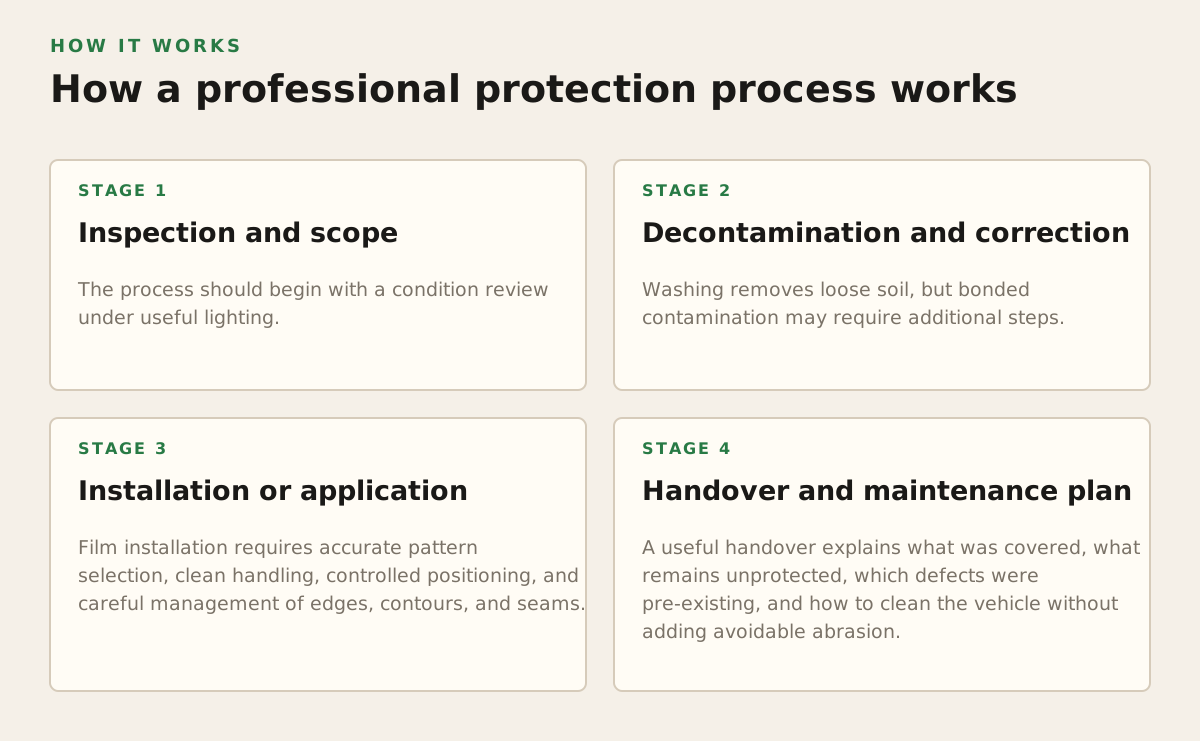
1. Inspection and scope
The process should begin with a condition review under useful lighting. The technician needs to identify previous touch-up work, repainted panels, failing clear coat, trim condition, chips, dents, corrosion, and areas that cannot accept a normal installation. The vehicle’s use matters just as much: a commuter, dealership unit, delivery van, and trail motorcycle should not automatically receive the same coverage map.
For a fleet manager, inspection also means deciding whether the priority is consistent appearance, reduced downtime, easier cleaning, resale presentation, or protection of high-contact areas. A repeatable scope is usually more valuable than giving every unit an identical package.
2. Decontamination and correction
Washing removes loose soil, but bonded contamination may require additional steps. Iron particles, tar, sap, mineral deposits, and old dressing can remain after an ordinary wash. Removing them reduces the chance that contamination will be sealed beneath a coating or interfere with film placement.
Correction is then selected according to the finish. Light polishing may be enough for a relatively new vehicle. A heavily swirled black SUV may need more correction, while a damaged or thinly finished panel may not be a candidate for aggressive polishing. The goal is not to chase every mark at any cost; it is to improve the surface without creating a new risk.
3. Installation or application
Film installation requires accurate pattern selection, clean handling, controlled positioning, and careful management of edges, contours, and seams. Coverage should be discussed in panel terms. “Full front,” for example, should be clarified so the owner knows whether it includes the bumper, hood, fenders, mirrors, headlights, or adjacent leading edges.
Coating application requires a similarly controlled surface. Residue, moisture, incompatible products, and poor environmental conditions can affect the final appearance. The product’s cure and aftercare instructions are part of the system, not optional paperwork. The owner should receive clear guidance about when and how the vehicle can be washed or exposed to weather after the work.
4. Handover and maintenance plan
A useful handover explains what was covered, what remains unprotected, which defects were pre-existing, and how to clean the vehicle without adding avoidable abrasion. For commercial operators, the plan should be simple enough for drivers or a wash vendor to follow consistently.
As an illustrative starting policy—not a universal benchmark—an owner might schedule:
- A gentle exterior wash whenever road film, salt, or bird residue is visibly accumulating rather than allowing contamination to bake on.
- A closer inspection of film edges and high-impact zones after a season of highway driving or gravel-road use.
- A professional condition review before selling, trading, wrapping, repainting, or transferring a fleet vehicle.
- Immediate evaluation of punctures, lifting edges, deep scratches, or contamination that will not release with safe washing.
The exact interval should follow the vehicle’s storage, mileage, climate exposure, and product instructions. A vehicle stored outdoors near industrial traffic needs a different routine from a weekend coupe kept indoors.
Where Paint Protection breaks down
Every protection system has a failure mode. Honest guidance identifies those limits before installation, especially for owners who expect a one-time treatment to eliminate maintenance.
Film is sacrificial, not indestructible
A film can be cut, punctured, lifted, stained, or damaged when the impact exceeds its ability to absorb it. A pressure washer aimed directly at an exposed edge can worsen lifting. Road debris can strike an uncovered portion of a panel. Poorly repaired paint may release during removal. These are reasons to discuss coverage boundaries and future repair procedures, not reasons to promise total protection.
Film also has an appearance trade-off. Edges, seams, complex curves, and areas with imperfect underlying paint may be more noticeable at close range. Pattern quality and installation skill matter, but even a careful installation cannot change the geometry of a panel or hide every defect underneath it.
Coatings do not stop impact
A coating can make washing and contamination management easier, but it is not a replacement for a physical barrier where stones routinely strike. It can also become less effective or less visually uniform when covered by traffic film, mineral deposits, oils, or incompatible maintenance products. “Permanent” or “long-term” language should be interpreted in light of actual care, exposure, and the product’s written requirements.
Ultraviolet exposure is one reason exterior finishes need ongoing care. The National Oceanic and Atmospheric Administration explains that ultraviolet radiation can affect materials and that exposure varies with factors such as sun angle, altitude, clouds, and reflective surfaces; see its UV radiation resource. A coating may help manage the surface, but it does not turn outdoor storage into indoor storage or eliminate the need to remove damaging contamination.
Winter creates a combined problem
Metro Detroit winter driving combines abrasive grit, moisture, freeze-thaw cycles, and deicing materials. The Federal Highway Administration discusses how roadway deicing practices affect transportation infrastructure and the environment in its road-salt research publication. That source does not establish a service guarantee for any vehicle treatment; it reinforces the practical point that salt exposure should be managed at the vehicle’s exterior and underside rather than treated as a cosmetic issue only.
After winter driving, the sensible response is removal and inspection:
- Rinse loose grit before making contact with the paint.
- Use separate tools for wheels, tires, and painted panels.
- Pay attention to lower doors, rocker panels, wheel arches, tailgates, and exposed film edges.
- Inspect the underside and drain areas for retained salt and packed debris.
- Do not use a coating or wax to conceal bubbling, corrosion, failing paint, or a lifting film edge.
Applying the decision to Metro Detroit vehicles and fleets
The most useful package is usually the one that protects the vehicle’s expensive or exposed areas without pretending every surface faces the same risk.
Personal cars, trucks, and sports cars
A daily commuter that spends hours behind trucks may justify film on the front bumper, hood, mirrors, and fender fronts, with a coating on the rest of the exterior if easier washing is important. A weekend sports car may justify broader visible-panel coverage because preserving original paint and appearance is part of ownership. A pickup used for hauling may need film on door edges and lower leading surfaces, while bed protection should be considered separately because cargo creates a different kind of damage.
For an older vehicle, start with condition rather than product enthusiasm. If the clear coat is failing or the panel has extensive chips, money may be better directed toward localized repair, correction where safe, or a realistic maintenance plan. Protection is most effective when applied to a sound, properly prepared surface.
Motorcycles, dirt bikes, ATVs, and powersports equipment
Powersports vehicles have concentrated contact zones. Boots rub side panels, straps touch painted surfaces, branches strike plastics, and fuel or trail contamination can remain in seams. Coverage should follow the contact map rather than the vehicle’s overall size. A street motorcycle may benefit from tank and luggage-contact protection. A dirt bike may prioritize shrouds and high-abrasion areas, with the understanding that aggressive trail use can exceed any film’s design.
Cleaning technique matters particularly on textured plastics and decals. The owner should confirm that the selected product is compatible with the substrate, graphics, flexible trim, and heat cycles. A product intended for smooth automotive paint is not automatically appropriate for every powersports surface.
Boats, jet skis, and RVs
Marine and recreational vehicles face long periods of sun exposure, water spotting, dock contact, trailer hardware, and storage contamination. Film may make sense at rub points or selected leading surfaces, while a coating may support routine cleaning on large painted or gel-coated areas if the specific system is compatible. RV owners should also separate painted body panels from decals, rubber seals, acrylic windows, and plastic components during planning.
The maintenance schedule should account for storage. A boat that is covered but repeatedly exposed to wet, dirty conditions has a different contamination problem from a trailered watercraft rinsed after every outing. A large RV or bus also rewards a practical scope: protecting high-contact areas and establishing a repeatable wash process may be more manageable than treating every square inch at once.
Dealerships, fleets, buses, and commercial vehicles
Fleet decisions should be based on operational cost and consistency, not just showroom appearance. Ask which panels are repeatedly damaged, how vehicles are washed, who performs inspections, and whether downtime is more expensive than scheduled protection work. A delivery fleet may value door-edge and loading-zone protection. A dealership may prioritize consistent presentation and safe reconditioning. A bus operator may need a maintenance procedure that works across many drivers and locations.
A practical fleet evaluation can use this checklist:
- Exposure map: Record the panels most affected by mileage, loading, curb contact, gravel, or repeated washing.
- Vehicle variation: Separate passenger vehicles, vans, buses, trailers, and specialty equipment instead of forcing one package onto all units.
- Wash process: Document tools, chemicals, drying methods, and pressure-washing habits that could create abrasion or lift film.
- Inspection trigger: Define when a unit is reviewed—after winter, after a collision, at scheduled service, or before resale.
- Repair path: Decide who evaluates damaged film, chips, corrosion, decals, and repainted panels before the problem spreads.
That approach makes paint protection a managed maintenance decision rather than a vague promise. For a Metro Detroit vehicle owner or fleet manager, the specific recommendation is to begin with an exposure map and a condition inspection, then combine film, coating, correction, detailing, and underbody services only where each one addresses a real risk. Rite-Way Auto Reconditioning works with personal vehicles, dealerships, fleets, boats, RVs, motorcycles, powersports equipment, buses, and commercial vehicles; Rite-Way Auto Reconditioning is a sensible next step when you want the coverage and maintenance plan matched to the way your vehicle is actually used.