Tesla Y paint protection film (PPF) is a clear film applied to painted surfaces to help take some of the wear from road debris and everyday contact. For a Model Y owner, the practical decision is which panels to cover, how the installer will fit the pattern to the specific vehicle, and what limits and care instructions apply. PPF can be damaged and does not make paint immune to chips or scratches, so compare written coverage and product terms rather than relying on a package name.
Decide what you want the film to protect
PPF is a physical layer over paint, not a repair to the paint beneath it. Manufacturers describe their films as protection against certain surface damage, including impacts from road debris and scratches; the outcome depends on the product, installation, surface condition, and the impact itself. For product-specific descriptions, review 3M Scotchgard Paint Protection Film and XPEL ULTIMATE PLUS. Those descriptions can help you understand the products being quoted, but they do not establish that every mark or impact will be prevented.
Start by identifying the kind of exposure that concerns you, then ask which painted surfaces in the proposal address it. A highway commute may make forward-facing panels a priority; frequent loading or close parking may lead you to ask about door areas and edges. These are useful ways to frame a coverage discussion, not predictions that a particular panel will be damaged. The use case should drive the panel list, not a package label that leaves the boundaries unclear.
- Mostly highway driving: ask which front-facing painted panels are included and where coverage ends.
- Gravel or construction routes: discuss the exposed areas you want covered and whether the proposed scope reaches them.
- Frequent loading or shared use: ask whether door edges or other regularly contacted painted areas can be included.
- Appearance-focused ownership: ask where film edges and seams will sit and how visible they may be on your paint.
A film can itself become marked or damaged, and a sufficiently forceful or sharp impact may affect paint underneath. “Self-healing,” where stated for a particular product, should not be read as a promise that all marks disappear. Check the specific film’s documentation and ask what kinds of surface marks its manufacturer says the feature addresses. If an impact or scratch is central to your concern, ask the installer to explain the limitation plainly before you choose coverage.
Compare coverage by the panels included
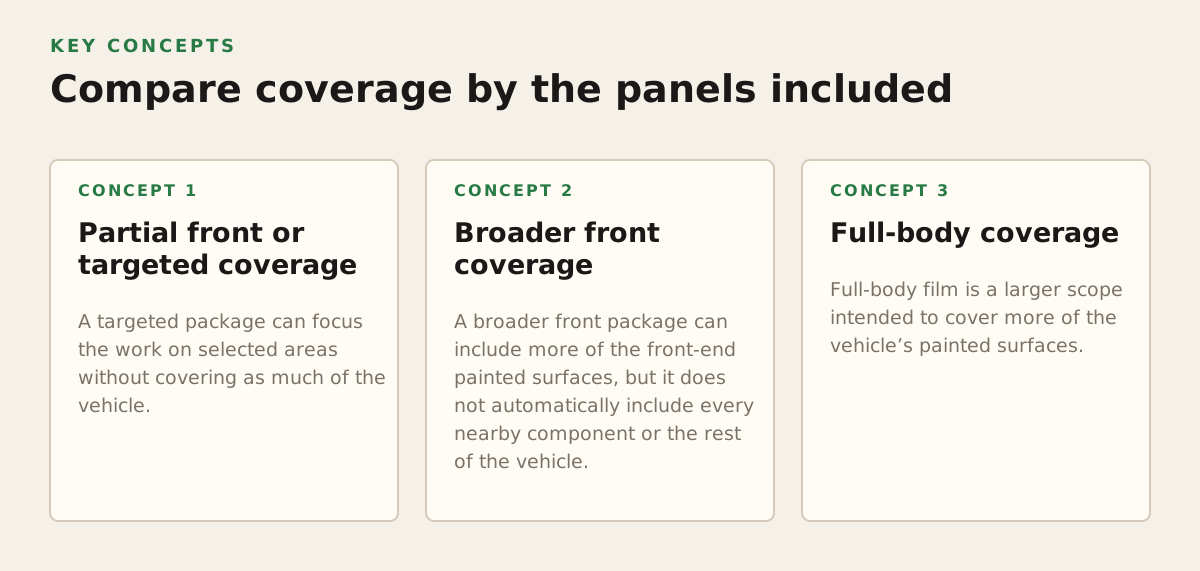
Labels such as “partial front,” “full front,” and “full body” are shorthand, not a universal definition of what a quote includes. Two proposals using the same label may differ in their panel boundaries or exclusions. Request a written list of covered panels and, if available, a diagram. A panel-by-panel scope makes quotes comparable and shows which painted surfaces will remain exposed.
Partial front or targeted coverage
A targeted package can focus the work on selected areas without covering as much of the vehicle. Its usefulness depends on exactly where the film stops. Ask whether a hood or fender is covered fully or only in part, and where any exposed line will fall. A boundary across a painted surface may be more noticeable than one placed at an edge, though appearance depends on the panel, film, paint condition, and viewing conditions. Have the installer show you the proposed cut lines for your Model Y instead of assuming the name tells you the coverage.
Broader front coverage
A broader front package can include more of the front-end painted surfaces, but it does not automatically include every nearby component or the rest of the vehicle. Confirm the listed panels and any exclusions, including wheel-area panels or other pieces you expect to be protected. If you drive frequently on highways, compare how much additional painted area is covered against the narrower option. The useful question is not simply whether one package is “more protection,” but which additional surfaces become covered.
Full-body coverage
Full-body film is a larger scope intended to cover more of the vehicle’s painted surfaces. Do not assume the phrase includes trim, unpainted parts, or every visible exterior component. Ask the installer to identify what is included, what is excluded, and how the film will be finished around edges and openings. A broader scope also means more of the vehicle’s paint condition and finish will be part of the installation discussion. Decide whether that coverage matches your priorities rather than choosing it simply because the package sounds comprehensive.
Use the same questions for each proposal so the comparison stays grounded in scope:
- Which specific painted panels are included, and which are not?
- Where will film edges or seams fall, and are any edges intended to be wrapped?
- What paint preparation is included, and will extra correction require your approval?
- Which film product is specified, and where are its care and warranty terms documented?
- What process applies if you notice lifting, film damage, or an installation concern?
Confirm fitment, paint condition, and finish
Before authorizing work, ask the installer to verify the pattern for your Model Y’s model year and relevant configuration. A generic “Model Y” description is not enough to confirm that a particular pattern is intended for your vehicle. Ask whether the proposed work uses a vehicle-specific pattern, whether any adjustment or hand-cut work is expected, and how those choices affect the coverage boundaries. Confirm fitment for the actual vehicle rather than inferring it from a package name or a general product listing.
Paint condition matters because clear film does not correct defects underneath it. A chip, scratch, or other mark may remain visible through the film. Tell the installer about known repainting, repairs, existing film, or paint damage before the vehicle is assessed. Ask whether inspection and correction are included, what additional work might be proposed, and whether you will approve it before it proceeds. These questions help avoid treating film installation as if it also restores the underlying finish.
Discuss the expected appearance and boundaries before work begins. Film edges can be visible, and a clean-looking result depends in part on the panel shape, paint condition, and where the pattern ends. Ask to review the planned coverage on the vehicle or a diagram and clarify how the installer approaches curved areas and panel edges. If a seamless appearance is important to you, ask what the proposed pattern can achieve and what limits remain. A specific explanation of seams and edges is more useful than an unqualified promise that film will be invisible.
Prepare these details for a quote discussion:
- Vehicle information: provide the model year and any configuration details requested for pattern verification.
- Paint history: mention known chips, scratches, repainting, repairs, or protection already on the vehicle.
- Driving and use: describe whether the Model Y is mainly used for commuting, highway travel, unpaved routes, or frequent loading.
- Desired coverage: identify priority panels and surfaces you are willing to leave uncovered.
- Written terms: request the product name, scope, care instructions, exclusions, and process for addressing concerns.
Do not assume a quote includes a particular warranty, turnaround, paint correction, or follow-up service unless the provider’s current written terms say so. If the proposal omits a detail that affects your decision, ask for clarification before scheduling.
Choose between PPF and ceramic coating
PPF and ceramic coating address different priorities. PPF is a physical film that can help shield the covered paint from some surface damage; ceramic coating is a surface treatment rather than a film barrier against impacts. If road debris and chips are the main concern, ask about PPF coverage. If your priority is a treated surface for appearance maintenance, ask whether a coating suits your goals. Neither option should be described as protection from every kind of damage.
Some owners may consider both, but the details matter: which product goes on which surface, whether the products are compatible, and which care instructions apply. Do not assume that coating over film is included or required, or that one product’s warranty covers the other. Ask the installer to identify the proposed products and explain their written terms for the specific combination. Rite-Way lists both coating and ppf among its service pages; the products and scope for a particular vehicle still need to be confirmed.
| Priority | Question to ask | Important limit |
|---|---|---|
| Help shield selected panels from road debris | Which painted panels does the PPF proposal cover? | Uncovered areas remain exposed, and film can be damaged. |
| Focus on surface care and appearance | Would a coating suit the paint and maintenance goals? | A coating is not a physical film barrier against impacts. |
| Address both priorities | Which product goes on each surface, and what terms apply? | Compatibility, coverage, and care directions need confirmation. |
For example, a Model Y owner who drives on highways but does not want broad coverage could compare a clearly specified front package with a targeted one. Someone more concerned with routine surface care could ask about coating instead. These examples illustrate how priorities shape the discussion; they do not predict damage or establish that one option is right for every vehicle.
Care for the film and make the final choice
After installation, follow the care instructions for the exact film and the installer’s guidance. Do not substitute general online advice if it conflicts with the product-specific directions. Tesla provides vehicle maintenance information; check its current guidance for your vehicle and ask the installer how it applies to newly installed film. Tesla’s Car Wash Mode guidance explains a vehicle wash setting, but it is not a replacement for film-specific care instructions.
When checking the film, look over the covered surfaces and edges without picking at a lifted area or attempting an improvised repair. If you notice a mark, lifting, or another change, take a clear photo and ask the installer whether an inspection is appropriate. A visible mark alone does not tell you whether the film, paint underneath, or both have been affected. The product and installation terms determine what follow-up applies, so keep those documents available.
Before you choose, compare the written panel list, pattern fitment, paint-preparation scope, product terms, and care instructions. If a proposal does not make clear what is covered or where the film ends, request a diagram or explanation rather than relying on the package label. For Greater Metro Detroit vehicle owners, Rite-Way Auto Reconditioning lists paint protection film installation, paint correction, and ceramic coating among its capabilities. Contact Rite-Way Auto Reconditioning to discuss the Model Y’s condition and verify the available scope and terms for your vehicle.